
Introduction
The decision of whether to use forged or spun (or formed) heads for pressure vessel design not only affects safety but also the service life and running costs in the long-term.
Spun heads are generally considered as a cheaper alternative for the construction of vessels. But for the cases of high pressure, high temperature or cyclic loading conditions, forged heads are the preferred choice for many operators.
With a very engineering-oriented approach this guide gives you a face-to-face comparison of the two alternatives for you to understand what is better for you.
What Are Forged Pressure Vessel Heads?
The working principle is to make the metal product –head in this case- take the desired shape by exerting very high compressive forces using it very plastic state. The main tools used for this purpose are large hydraulic presses and forging hammers.
The restructuring of the grain and closure of voids make the resulting material very dense and uniform in nature.
Some distinguishing features:
- Grain flow being enhanced and aligned with the direction of stress
- Very strong structurally
- Near absence of internal defects
- Superb fatigue resistance
Forged heads are almost always the first choice for vessels meant to operate in high pressure and temperature producing environments and with safety being a big concern
What Are Spun (Formed) Pressure Vessel Heads?
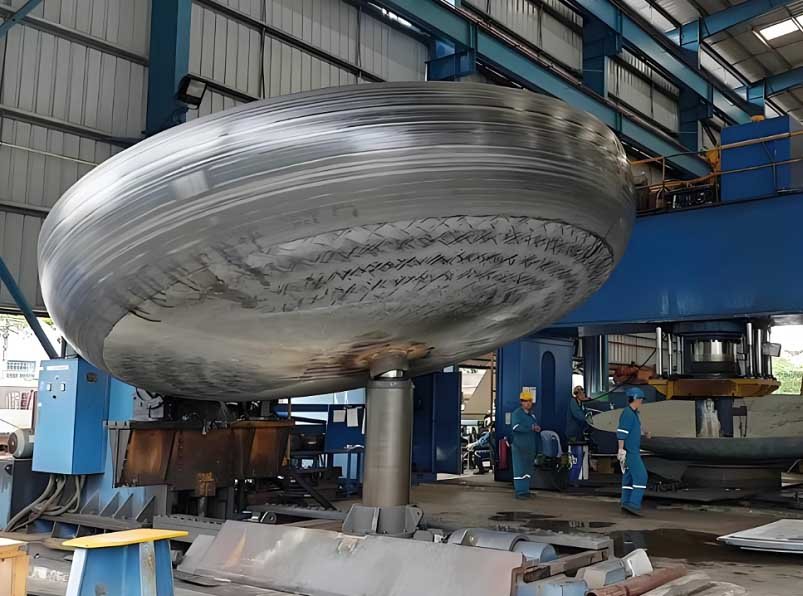
Spun heads are made by turning a sheet of metal and then shaping it with rollers (spinning) or by pushing it against a previous form (stamping).
Main features:
- Low-cost production
- Compatible with thin to medium thickness
- Shorter manufacturing time
- Extensively used for the production of standard vessels
Nevertheless, the metal may be thinned and residual stresses generated as a result of the forming operation. These two issues may limit their usability in severely demanding conditions.
Forged vs Spun Heads: Key Differences
| Property | Forged Heads | Spun Heads |
| Manufacturing Process | Plastic deformation (forging) | Forming (spinning/stamping) |
| Internal Structure | Dense, uniform | Possible thinning and residual stress |
| Mechanical Strength | High | Moderate |
| Fatigue Resistance | Excellent | Limited |
| Thickness Control | Uniform | May vary (thinning zones) |
| Defect Risk | Low | Higher (especially in thick sections) |
| Cost | Higher | Lower |
| Suitable Applications | Critical, high-load | Standard service |
Performance Comparison in Real Applications
High-Pressure Vessels
In high-pressure applications, forged heads provide better load distribution and reduce the risk of stress concentration.
Spun heads may be sufficient for moderate pressure, but under extreme pressure, their reduced thickness zones can become weak points.
High-Temperature Environments
Forged heads maintain better structural stability due to their refined microstructure.
Spun heads, especially those with residual forming stress, may experience distortion or accelerated degradation.
Cyclic Loading and Fatigue Conditions
In applications such as reactors or pressure vessels with frequent start-stop cycles:
- Forged heads show significantly longer fatigue life
- Spun heads are more prone to crack initiation at stress concentration areas
When Should You Choose Forged Heads?
Forged pressure vessel heads are recommended when:
- Design pressure is high
- Operating temperature is elevated
- The vessel is subject to cyclic loading
- Safety requirements are critical (e.g., hydrogenation reactors, nuclear equipment)
- Thick-section components are required
In these cases, the higher initial cost is justified by improved reliability and longer service life.
When Are Spun Heads a Better Choice?
Spun heads are suitable when:
- Pressure and temperature are moderate
- Budget is a key concern
- Large quantities of standard vessels are required
- Thickness is relatively small
- The application is not safety-critical
They provide a good balance between cost and performance for general industrial use.
Cost vs Lifecycle Value
One of the most common misconceptions is focusing only on initial cost.
- Spun heads: Lower upfront cost, but higher risk of maintenance or replacement
- Forged heads: Higher initial cost, but longer service life and lower failure risk
�� For critical equipment, forged heads often result in lower total lifecycle cost.
Common Failure Risks
Spun Heads
- Thickness thinning at crown or knuckle
- Residual stress leading to cracking
- Reduced fatigue resistance
Forged Heads
- Generally lower failure risk
- Failures are usually linked to material defects or improper heat treatment (rare when properly controlled)
How to Choose the Right Option
When selecting between forged and spun heads, consider:
- Design pressure and temperature
- Corrosive environment
- Required service life
- Safety classification
- Budget constraints
�� A practical rule:
- Standard conditions → Spun heads
- Critical conditions → Forged heads
Our Forged Pressure Vessel Head Solutions
At TIPTOP, we specialize in high-quality forged pressure vessel heads for demanding applications.
We offer:
- Materials: Q345R, 15CrMoR, stainless steel, duplex, nickel alloys
- Large-diameter and thick-section capabilities
- Full-process manufacturing (forging, heat treatment, machining)
- Complete NDT and certification
FAQ: Forged vs Spun Heads
Q1: Are forged heads always better than spun heads?
Not always. Forged heads are better for critical applications, while spun heads are sufficient for standard conditions.
Q2: Why are forged heads more expensive?
Because they require more complex manufacturing processes and higher material utilization.
Q3: Can spun heads fail under high pressure?
Yes, especially in areas where thickness thinning occurs.
Q4: Which option has longer service life?
Forged heads generally last longer due to better fatigue resistance and structural integrity.