
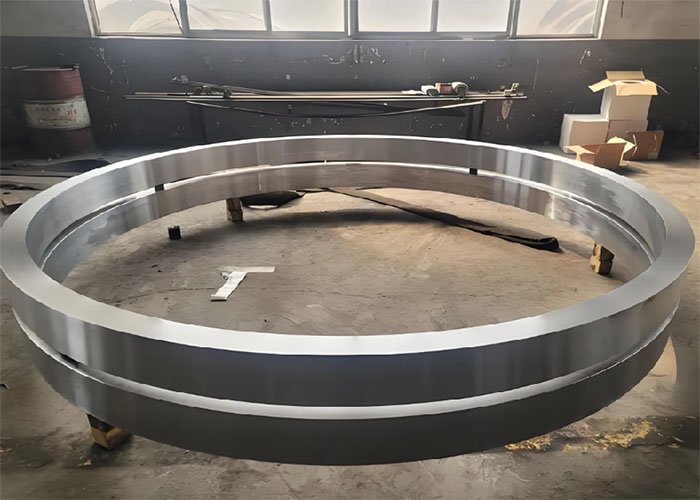
AISI 4140 Large Forged Rings | Open-Die Forged & Ring Rolled Components for Wind Power & Oil/Gas
Looking for high-strength AISI 4140 large forged rings? We supply ring rolled and open-die forged components (up to 25t) with continuous grain flow for wind power, oil & gas, and heavy machinery. Features: EAF+LF+VD smelting, UT tested, and Q&T delivery. Request a quote today
Description
1. Introduction to AISI 4140 Large Forged Ring Forgings
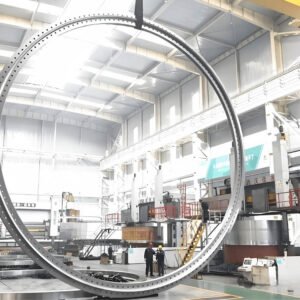
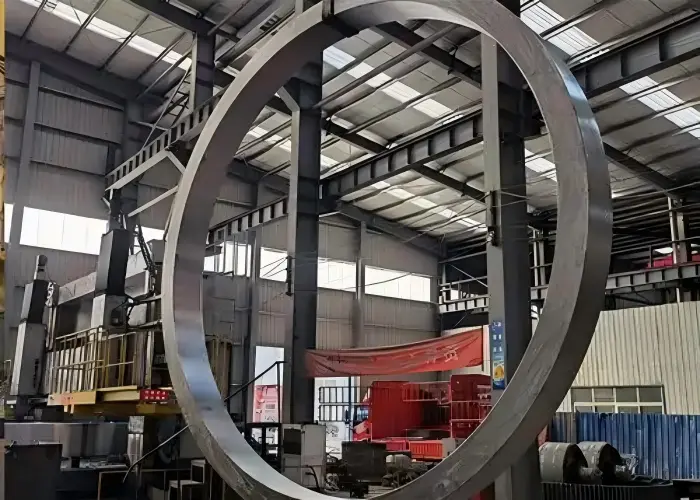
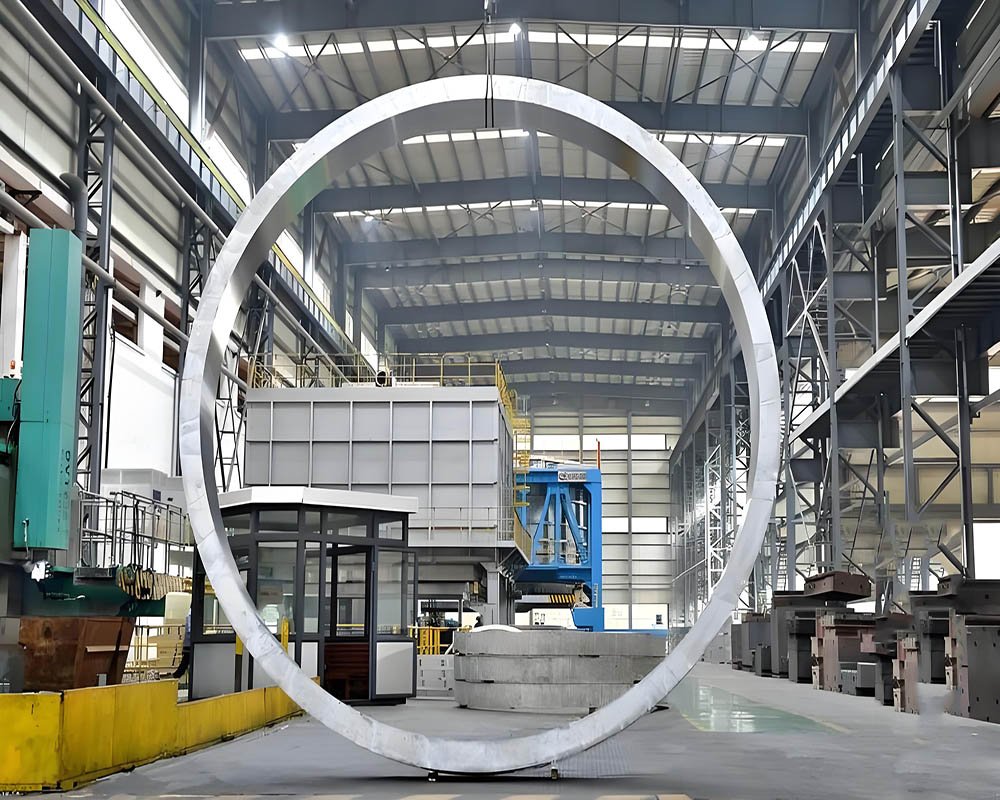
Large AISI 4140 forged rings are made from steel ingots through open-die forging and ring rolling. This process creates continuous circumferential grain flow lines and eliminates casting defects like porosity. The elongated grains provide superior tangential strength, fatigue life, and impact resistance. Therefore, they are the ideal choice for high-load, high-reliability rotating or pressure-bearing components.
2. Why is AISI 4140 Suitable for Manufacturing Large Forged Rings?
The suitability of AISI 4140 for large ring forgings stems from the alignment between material properties and the service conditions of the ring, rather than the prominence of a single performance metric.
Balance of hardenability and cross-sectional uniformity: The toughness does not suffer significantly as strength increases, and the cutting resistance during subsequent gear shaping, drilling, and slot milling is not excessive. The surface is also less sensitive to cracking, making it highly suitable for the long-cycle “forging – rough machining – finish machining” manufacturing process of large rings.
Synergy of strength, toughness, and machinability: After ring rolling, the grain flow lines are continuously distributed along the circumference, generally aligning with the tangential principal stress during service.
Synergy of circumferential fiber flow lines and toughness: The quenching and tempering process window for 4140 is relatively wide. The quenching temperature is typically 850–880 °C, and tempering is adjusted within the 550–650 °C range according to the target hardness.
Mature heat treatment and welding support systems: AISI 4140 has a wide quenching and tempering process window, with a quenching temperature of approximately 850–880 °C, and a tempering temperature adjustable within 550–650 °C based on the target hardness. Meanwhile, although the weldability of AISI 4140 is not excellent, local repair welding can still be performed under controlled preheating and post-weld heat treatment conditions, providing process flexibility for managing minor defects in large rings during manufacturing or service.
3. Material Properties of AISI 4140 (Standard Chemical Composition Range and Mechanical Properties)
Typical Chemical Composition Range
| Element | Range (%) |
| C | 0.37–0.44 |
| Si | 0.10–0.35 |
| Mn | 0.65–1.10 |
| P | ≤ 0.040 |
| S | ≤ 0.040 |
| Cr | 0.75–1.20 |
| Mo | 0.15–0.30 |
Mechanical Properties (Typical Values in Q&T Condition)
| Diameter/Cross-section (mm) | Tensile Strength (MPa) | 0.2% Yield Strength (MPa) | Elongation (%, 50mm) | Hardness (HB) |
| ≤ 180 | 930–1,080 | ≥ 740 | ≥ 12 | 269–331 |
| > 180–250 | 850–1,000 | ≥ 665 | ≥ 13 | 248–302 |
4. Specifications and Sizes of AISI 4140 Large Forged Rings We Can Supply
| Parameter | Rolled Rings (Ring Rolling) | Open Die Forged Rings |
| Outer Diameter | 300–5,000 mm | 300–3,500 mm |
| Wall Thickness (Radial) | 30–500 mm | 50–600 mm |
| Height (Axial) | 30–1,000 mm | 60–1,200 mm |
| Single Piece Weight | Max. approx. 12 t | Max. approx. 25 t |
The delivery condition can be selected based on the subsequent machining path: as-forged (black surface), normalized, quenched and tempered (Q&T), or rough/finish machined according to drawings. The forging ratio is generally controlled at ≥ 3:1, and can be requested at ≥ 4:1 for critical rings to ensure core density and flow line continuity.
5. Forging Process for AISI 4140 Large Forged Rings
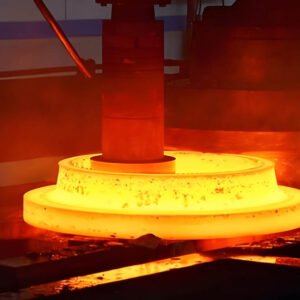
The typical pipeline process route for large AISI 4140 ring forgings is: Cutting → Rotary Heating → Forging & Ring Rolling → Direct Quenching → Immersion Ultrasonic Testing → Tempering → Machining.
Smelting and Ingot Preparation: Large rings have higher requirements for steel purity and density than small and medium forgings. It is advisable to adopt a triple smelting route of EAF (Electric Arc Furnace) + LF (Ladle Furnace) refining + VD (Vacuum Degassing) to control H, O, N, P, and S contents. After removing the riser and bottom tail, the ingot is used as the forging billet.
Key Process Control Points:
- Forging ratio ≥ 3.0 (≥ 4.0 for critical heavy-duty parts)
- Initial forging temperature 1150–1200°C, final forging temperature ≥ 850°C
- Furnace temperature uniformity within ±15°C
- Smelting route: EAF + LF + VD (Vacuum Degassing) to reduce H, O, and inclusion levels.
6. Application Areas of AISI 4140 Large Forged Rings
The applications of AISI 4140 large forged rings are concentrated in rotating and pressure-bearing components that require “high load, alternating stress, and long service life.” Core fields include:
- Wind Power: Yaw/pitch bearing rings, gearbox rings, tower flanges.
- Oil & Gas: Wellhead equipment rings, drilling and extraction system load-bearing rings, pressure control components.
- Heavy Transmission / Construction Machinery: Slewing bearing rings, gear blank rings, bearing rings, flange rings.
- Power Generation & Pressure Equipment: Steam/gas turbine rings, pressure vessel rings.
- Mining & Marine: Crusher/mill rings, offshore load-bearing rings.
7. Packaging and Delivery of AISI 4140 Large Forged Rings
Preparing the big forged ring for transport and shipment goes far beyond “wrap and delivery.” It involves control over the prevention of deformation, rust prevention, traceability, and lifting safety as well. With rings measuring outer diameters of a few meters and having unit weights of dozens of tons, the methods of transportation support and the design of lifting points have a direct effect on dimensional stability.
7.1 Surface Protection: Machined surfaces (such as sealing surfaces, tooth surfaces, and raceways) are treated with anti-rust grease or peelable protective coatings.
7.2 Packaging and Fixation: Usually, the rings are placed on steel pallets or wooden blocks for support with the supporting points distributed evenly so that they do not ovalize due to gravity or vibrations. For the cases of rings with thin wall or a large diameter, temporary radial supports or interior bracing frames are necessary. Wood packaging exported items must comply with a series of wood packaging quarantine requirements as well.
7.3 Paperworks and Documentation: The typical delivery papers include:
- Certificate of Material (EN 10204 3.1, up to 3.2)
- Heat treatment time – temperature curve records
- Ultrasonic test results
- Inspect. Rep.
- Hardness / Mechanical Properties Testing Reports
- A traceability matrix matching heat numbers and ring numbers with the documents is also part of documentation