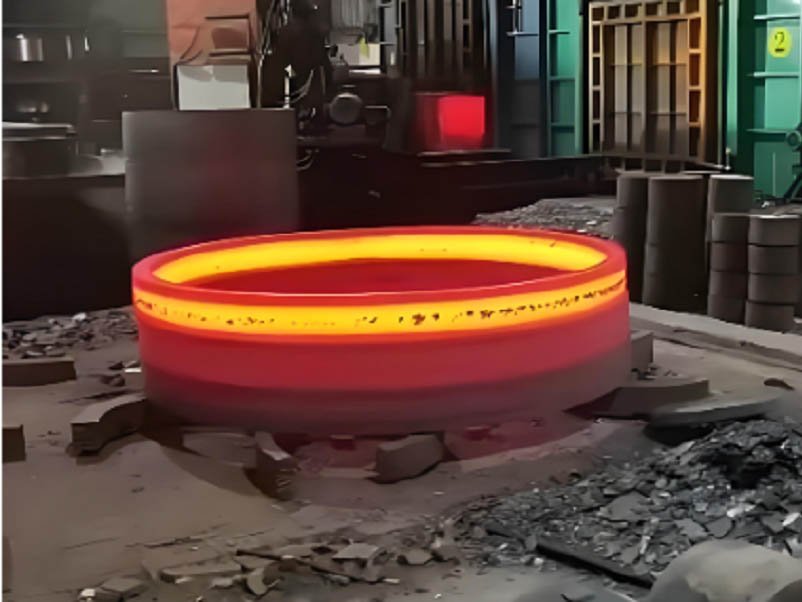
Q355NE Wind Power Flange Forging for Wind Turbine Applications
Wind turbine flanges are very important parts in the structure that help to join the tower, nacelle, and blade systems. Since they are the main contact points through which loads are transferred, they need to be able to resist various load types such as torque, bending moments, and other environmental factors, which are acting throughout their function period.
TIPTOP offers a range of Q355NE wind power flange forgings suited for both onshore and offshore wind turbine scenarios. We use a high-quality low-alloy steel in combination with the forging and heat treatment processes, which control the properties of the steel, so that the quality and performance of the flange keep up with the needs of the long-term service, even under the extreme conditions such as low temperature, high humidity, and marine corrosion.
Description
Introduction
Wind turbine flanges are very important parts in the structure that help to join the tower, nacelle, and blade systems. Since they are the main contact points through which loads are transferred, they need to be able to resist various load types such as torque, bending moments, and other environmental factors, which are acting throughout their function period.
TIPTOP offers a range of Q355NE wind power flange forgings suited for both onshore and offshore wind turbine scenarios. We use a high-quality low-alloy steel in combination with the forging and heat treatment processes, which control the properties of the steel, so that the quality and performance of the flange keep up with the needs of the long-term service, even under the extreme conditions such as low temperature, high humidity, and marine corrosion.
Why Q355NE Is Used Widely for Wind Turbine Flanges
Choosing the right material is one of the most important decisions that affects how long and safe the wind turbine structures will be.
Q355NE is a normalized low-alloy structural steel, which is not only a good toughness at low temperature but has also been specially designed to maintain its impact properties even at -40°C, which is a main reason why it is considered an excellent choice for wind farms in cold regions or at high altitudes.
Compared to other standard structural steels, Q355NE is known for a better or optimal mixture of strength, ductility, and weldability. These properties make it suitable for use in tower flange connections where both structural integrity and long-term fatigue resistance are of importance.
When talking about components that need to bear higher loads like yaw and pitch flanges, materials such as 42CrMo4 or Q420NE are considered to be the material of choice in order to fulfill the higher that strength requirement.
Material Selection Strategy for Different Wind Turbine Components
Turbine flanges are not uniform products. Each part of the turbine needs to possess unique material characteristics.
Tower flanges mostly work with Q355NE or S355NL to have enough low-temperature toughness combined with structural stability. Offshore tower segments could even be made of materials of a higher grade such as S355NL or EH36, along with corrosion protection systems resulting in resistance to salt spray and laminar tearing.
Yaw flanges, main bearing flanges, and pitch flanges need to endure much more complicated loads like rotational forces and vibration. As a result, these elements will often need higher-strength steel such as 42CrMo4 or Q420NE to guarantee their long-term fatigue capability.
This approach to materials selection makes sure that every single flange is well-suited for its exact operating environment while also preventing both lack of performance and the rise of cost due to excessive use of materials.
Manufacturing Process: From Steel Purity to Final Forging
The integrity and performance of wind power flange forgings are heavily reliant on how well the processes are controlled.
The manufacturing process at TIPTOP starts with steel of high purity that is made by electric arc furnace smelting, LF refining, and vacuum degassing. The result of this process is steel with low contents of both hydrogen and oxygen, which greatly lowers the chances of occurrence of internal defects.
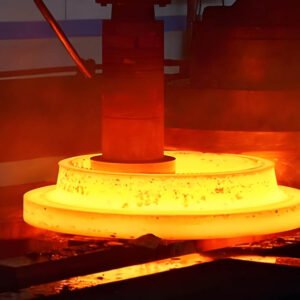
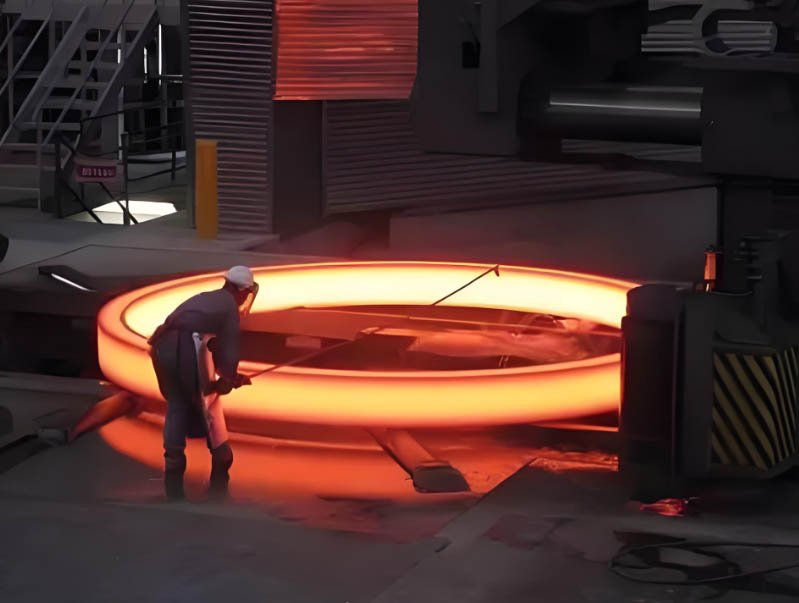
To avoid central segregation and shrinkage cavities in the case of big-sized flanges, ingot casting is used. Forging is a process where controlled deformation is done, which leads to grain structure refinement and better internal density.
Heat treatment is a process that is very carefully controlled so as to get a slightly better grade size (Grade 6 or better), which at the same time that strength is increased, the toughness is maintained. Every single step is being very closely checked so as to keep the product consistent and dependable.
Quality Control and Full Traceability
Wind turbine flanges operate under long-term cyclic loading, making quality control essential.
Each Q355NE flange forging is fully traceable to its original steel batch. Incoming materials are re-tested for chemical composition, tensile properties, and low-temperature impact performance.
Additional inspections include hardness testing, metallographic analysis, and non-destructive testing to detect internal defects. For critical components, 100% ultrasonic testing is performed to ensure structural integrity.
This comprehensive quality control system ensures that every flange meets strict performance requirements before delivery.
Engineering Value: Safety, Cost Efficiency, and Adaptability
From an engineering perspective, the value of a wind turbine flange lies in its ability to deliver long-term reliability under varying conditions.
By combining high-purity materials with controlled forging and heat treatment, Q355NE flange forgings provide a strong safety margin against fatigue failure and structural instability.
At the same time, precise material selection helps avoid over-engineering, reducing overall project cost while maintaining performance. With a complete material range from Q355NE to higher-strength alloys, TIPTOP can adapt to different environmental and load requirements across global wind farm projects.
Why Choose TIPTOP Wind Power Flange Forgings?
TIPTOP focuses on producing high-quality forged flanges for wind turbine applications, with strong capabilities in large-size forging and strict quality control.
Our experience in supplying both onshore and offshore projects allows us to provide tailored solutions based on actual operating conditions. From material selection to final inspection, every step is designed to ensure reliability and long service life.
Request a Custom Wind Turbine Flange Solution
If you are sourcing Q355NE wind turbine flanges or planning a new wind power project, our engineering team can help you select the right material and forging solution.
Send us your technical drawings or specifications, and we will provide a customized quotation and production plan.