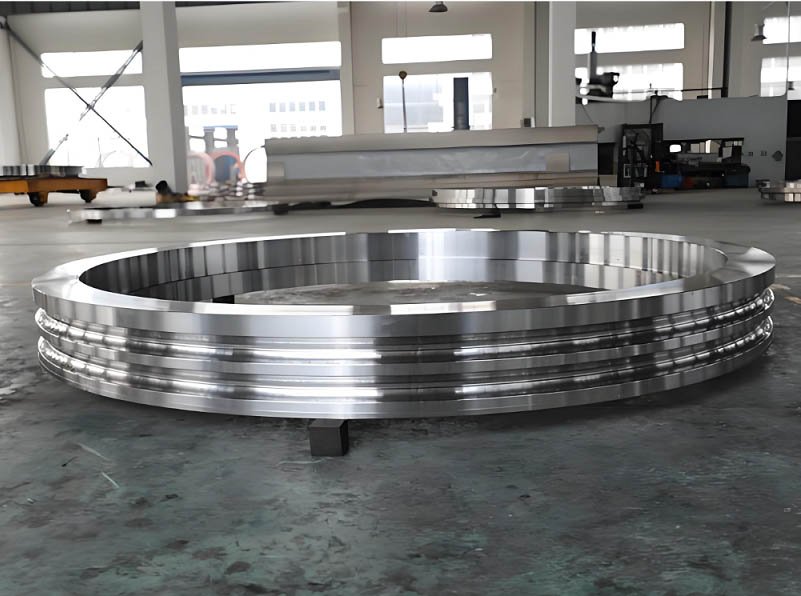
42CrMo4 Wind Power Flange Forging for Wind Turbine Towers
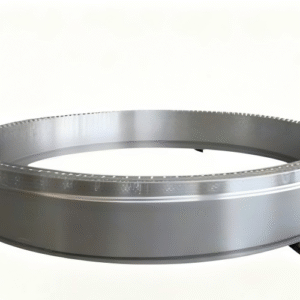
Wind power flange forgings are key structural elements in a wind turbine. They are used to link the main parts of a wind turbine, namely tower, nacelle, and blade systems. As major load carriers, these flanges have to resist various forces such as torque, shear, and bending moments, besides bearing the whole weight of the turbine under constant dynamic loading.
Description
Introduction
Wind power flange forgings are key structural elements in a wind turbine. They are used to link the main parts of a wind turbine, namely tower, nacelle, and blade systems. As major load carriers, these flanges have to resist various forces such as torque, shear, and bending moments, besides bearing the whole weight of the turbine under constant dynamic loading.
TIPTOP is a producer of wind power flange forgings 42CrMo4 specifically aimed at onshore and offshore wind turbine applications. Our flanges ensure equipment performance and reliability during the whole spanning life of the turbine, being able to withstand harsh conditions such as low temperatures, salt spray, and high wind loads.
The Reason for Using 42CrMo4 Forged Wind Power Flanges
For a wind turbine, the reliability of the flanges can determine the tower stability and safety in operation. A comparison of welding, casting, and forging reveals that the densest and more even grain flow structure is typical of forging, which results in better fatigue resistance and mechanical strength.
Manufacturers producing wind turbine flanges favor 42CrMo4 steel due to its high hardenability, good toughness, and suitability for dynamic loading. When this steel is quenched and tempered, it combines strength and ductility very well, which is a necessary condition for components exposed to long-term cyclic stresses.
Flanges forged from 42CrMo4 steel can give wind power plants the extra safety they need because of their higher corrosion and fatigue resistance that standard structural steels can’t match. These are especially relevant to offshore wind power facilities where such problems are more widespread.
Wind Power Flanges and Their Roles Wind Power Flanges
Wind turbine flanges are made by considering their location of installation and the type of load that will be the working one, and this is how each one of them corresponds to a particular role in the structural system of a wind turbine.
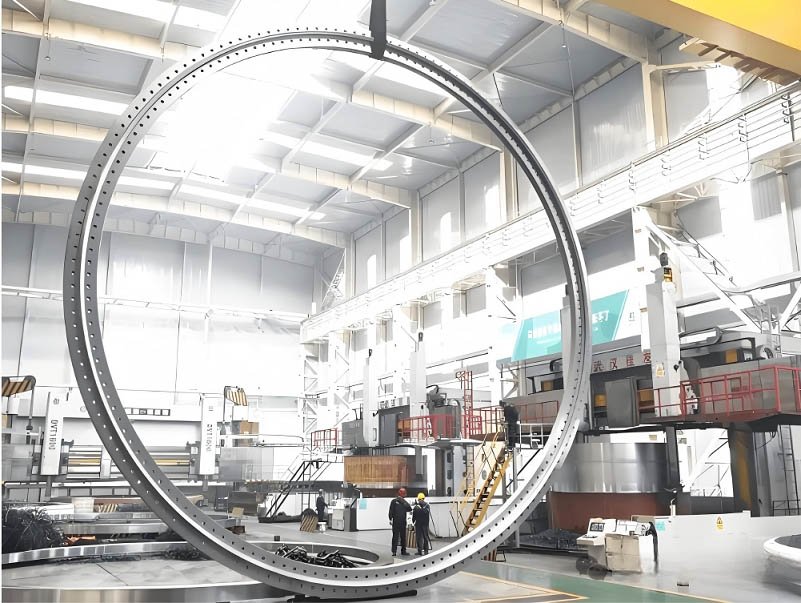
Two separate flanges hold parts of the tower together. Since tower height generally exceeds 100 meters nowadays, the flanges are characterized by extremely high flatness and concentricity, which ensures vertical alignment and hence, structural stability.
Yaw flanges facilitate the connection between the nacelle and the tower and transmit the rotational forces occurring during yaw movement. These parts have to remain precisely meshed and resistant to wear despite the continuous rotation.
Main bearing, pitch, and hub flanges are situated between the hub and blade root. Due to the extreme variability of the loading being exerted on these components such as vibrating, different stress levels, and impact, fatigue resistance and low-temperature toughness have become two of the most vital features that a designer must pay attention to.
Manufacturing Process: Raw Material to Final Product
Manufacturing process has a very big impact on the quality of wind turbine flange forgings.
TIPTOP’s work starts with high-purity steel ingots – 42CrMo4, Q355NE, and S355NL for example – where we keep the impurity (especially phosphorus and sulfur) level at an extremely low level guaranteeing better toughness and weldability.
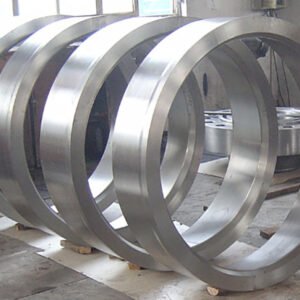
Unlike experience and manual inspection, grain flowing and internal defect removal are recorded and realized at the stage of forging by means of large-scale ring rolling equipment (up to 10,000-ton capacity). In the end, material densification and fatigue resistance were improved.
Heat treatment is controlled by quenching and tempering to obtain a fine grain structure (Grade 6 or better level). Even at very low temperatures such as -40°C or -50°C, the material still keeps its high impact toughness and therefore is ensured for good and stable operation at cold climates.Precision machining is carried out using large CNC vertical turning and milling centers, enabling tight control over flatness, parallelism, and dimensional accuracy. Surface protection is achieved through thermal zinc spraying combined with sealing coatings, meeting ISO 12944 C5-M standards for marine corrosion resistance.
Technical Capabilities and Customization Range
TIPTOP wind power flange forgings are designed to meet the increasing demand for large-megawatt turbines.
We support flange diameters ranging from 500 mm up to 8,000 mm, with single-piece weights from 0.5 to 25 tons. Custom designs are available for turbines exceeding 10 MW capacity, including special hole configurations and connection methods.
All products comply with international standards such as EN 10204 3.1 and JB/T 11218, and undergo 100% ultrasonic testing to ensure internal integrity. Inspection standards can meet EN 10228-3 or SEP 1921 requirements.
Performance in Onshore and Offshore Wind Applications
In onshore wind farms, flanges must withstand large temperature variations, sand, and dust exposure. In these conditions, structural stability and fatigue resistance are essential to ensure long-term operation.
Offshore wind turbines present even more demanding challenges, including salt spray corrosion, wave impact, and typhoon loads. Under such conditions, corrosion protection and material reliability become critical factors.
TIPTOP flange forgings are designed to perform reliably in both environments, supporting turbine models from 1.5 MW to 10 MW and beyond, including floating offshore platforms.
Quality Assurance and Full Traceability
For critical structural components like wind turbine flanges, quality assurance is not optional—it is fundamental.
TIPTOP implements full-process traceability, providing material certificates, heat numbers, and complete production records for each product. Dimensional inspection is conducted using advanced measurement systems, including laser tracking technology.
Non-destructive testing, including ultrasonic and magnetic particle inspection, is applied to detect any internal or surface defects. Only products that meet strict acceptance criteria are released for delivery.
Our manufacturing system is certified to ISO 9001, ISO 14001, and ISO 45001 standards, ensuring consistent quality and compliance with international requirements.
Why Choose Forged Wind Power Flanges from TIPTOP?
Choosing a reliable supplier for wind turbine flanges is essential for ensuring long-term operational safety.
TIPTOP combines advanced forging capability, strict quality control, and extensive experience in large-scale forging production. Our flanges are engineered to provide long service life, high reliability, and stable performance under extreme conditions.
By working closely with clients, we deliver customized solutions that match real project requirements, helping reduce risk and improve overall project efficiency.
Request a Custom Wind Turbine Flange Solution
If you are sourcing wind power flange forgings for onshore or offshore projects, our engineering team can support you with material selection, structural design, and production planning.
Send us your drawings or technical requirements, and we will provide a tailored solution and quotation.