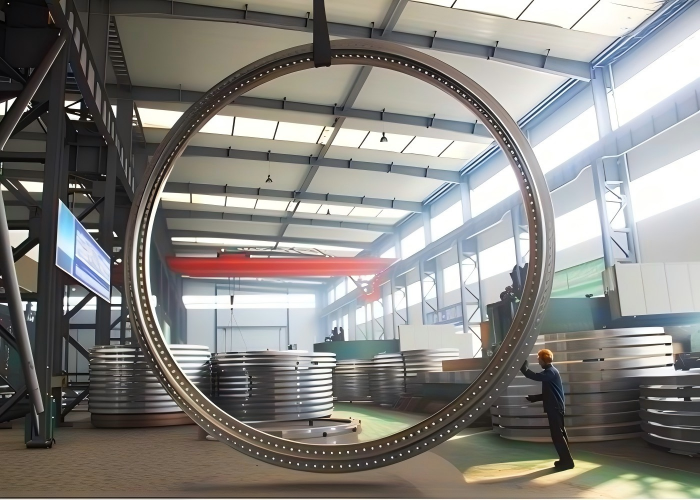
Q355NE Offshore Wind Flanges – Large Ring Forgings with Custom Manufacturer
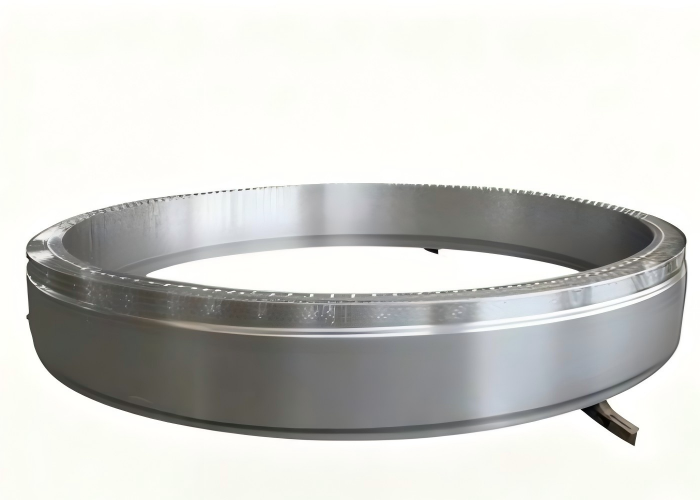
Offshore wind power flanges are critical large‑diameter ring forgings that connect the tower sections, foundation, and nacelle of a wind turbine. They are manufactured from Q355NE low‑alloy high‑strength structural steel, in compliance with the Chinese national standard GB/T 1591‑2018.
Description
1. Introduction to Q355NE Offshore Wind Power Flanges
Offshore wind power flanges are critical large‑diameter ring forgings that connect the tower sections, foundation, and nacelle of a wind turbine. They are manufactured from Q355NE low‑alloy high‑strength structural steel, in compliance with the Chinese national standard GB/T 1591‑2018.
As a key load‑bearing component of the entire turbine system, these flanges must continuously withstand alternating wind loads, wave impacts, low‑temperature conditions, and complex stress scenarios throughout their service life. That is why we set stringent requirements for the material: it must combine high strength, reliable low‑temperature impact toughness at ‑40 °C, excellent weldability, and strong resistance to lamellar tearing.
These flanges are widely used in offshore wind farms – whether as butt flanges between tower sections or as connection flanges between the tower base and the foundation transition piece, their stable support is indispensable. In essence, they act both as the connectors of the wind turbine “skeleton” and as the guarantors of long‑term, reliable operation.
2. What is Q355NE and Is It Suitable for Offshore Wind Flanges?
Q355NE is a low‑alloy high‑strength structural steel with excellent combined mechanical properties, weldability, and machinability. It is equivalent to the European standard S355NL.
Key advantages for offshore wind flanges:
- Outstanding low‑temperature toughness: Stable impact performance at −40 °C, suitable for high‑latitude and severe winter conditions, preventing brittle fracture.
- Balance of strength and ductility: Yield strength ≥355 MPa (≥265 MPa for thick plates), tensile strength 470–630 MPa, elongation ≥17 %, meeting high load and alternating stress demands.
- Excellent weldability: Low carbon equivalent, requiring only 80–120 °C preheating for thick plates, reducing cold cracking risk – ideal for flange circumferential and bevel welding.
- Resistance to lamellar tearing: Available with Z35 grade (reduction of area ≥35 %), solving lamellar tearing issues in thick flanges.
- Weathering suitability: Uniform normalized structure resists marine atmospheric corrosion; with protective coatings, it ensures long‑term stable service.
In summary, Q355NE is an ideal material for offshore wind flanges, fully matching the extreme conditions of marine environments.
3. Maximum Size Range of Q355NE Offshore Wind Flanges We Can Produce
We have large‑scale manufacturing capabilities for big‑diameter, heavy‑wall Q355NE offshore wind flanges. Maximum dimensions cover:
- Outer diameter: φ1200 mm – φ5000 mm (up to 5 meters, suitable for 10 MW and larger offshore turbine towers)
- Inner diameter: φ800 mm – φ4600 mm (customised per design)
- Thickness: 80 mm – 450 mm (heavy‑wall flanges for heavy‑duty foundation connections)
- Height: 100 mm – 300 mm; non‑standard special‑shaped flanges can be customised
Process: Supports integral ring rolling forging and welded assembly plus normalising and tempering. For 5‑metre‑class flanges, roundness deviation is controlled within ≤5 mm, meeting stringent wind power dimensional accuracy standards.
4. Key Manufacturing Processes for a Qualified Offshore Wind Q355NE Flange
1) Raw material control from the source
We start with Q355NE‑Z35 grade billets. Incoming material undergoes spectral analysis to strictly verify carbon equivalent, sulphur/phosphorus content, and microalloying elements. The melting route combines electric arc furnace + LF refining + VD vacuum degassing to effectively reduce inclusions and gas content, laying a solid foundation for quality.
2) Forging – building the “skeleton”
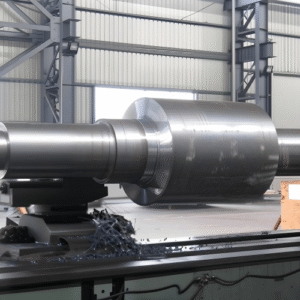
From cutting, heating (1200–1250 °C), upsetting, punching, to ring rolling, every step aims to preserve complete metal flow lines and a dense internal structure, with a forging ratio of no less than 4:1. We precisely control the final forging temperature to prevent abnormal grain growth and ensure internal integrity.
3) Heat treatment – unlocking material potential
After rough turning, we apply normalising plus tempering: normalising at 900–930 °C with holding followed by air cooling to refine grain size; tempering at 550–600 °C to relieve internal stresses and stabilise structure and toughness. We avoid prolonged exposure above 650 °C to protect low‑temperature performance.
4) Precision machining – shaping the final contour
The sequence includes rough turning, ultrasonic testing (UT) (meeting Class I standard, individual defects ≤φ4 mm), finish turning, magnetic particle testing (MT), coordinate measuring machine (CMM) dimensional inspection, bevel machining, and finally marking/steel stamping – each step ensures precise dimensions and appearance.
5) Full‑scale inspection and performance verification
UT and MT inspections are carried out throughout production. For each batch, −40 °C low‑temperature impact, tensile, and Z‑direction property tests are performed, with test reports issued by CMA/CNAS‑accredited laboratories, ensuring full traceability.
6) Proper anti‑corrosion and packaging
Finally, the surface is blast‑cleaned to Sa2.5 level, coated with anti‑corrosion primer, and packed in moisture‑proof packaging to provide comprehensive protection during sea freight and warehousing, ensuring the product reaches you in perfect condition.
5. How We Ensure Low‑Temperature Impact Toughness of Q355NE Flanges
1) Raw material control
- Use Q355NE‑Z35 billets with microalloying (Nb, V, Ti) for grain refinement; S ≤005 %, P ≤0.025 % to minimise impurity damage to toughness.
- Control carbon equivalent ≤45 % to balance low‑temperature toughness and weldability.
2) Forging and heat treatment optimisation
- Forging ratio ≥4:1 to break down coarse grains and ensure uniform structure.
- Precise normalising temperature (900–930 °C), holding time calculated by plate thickness, air cooling to achieve grain size ≥
- Tempering at 550–600 °C to relieve stress without impairing toughness.
3) Welding and machining control
- For thick plates (>25 mm), preheat to 80–120 °C, use low‑hydrogen consumables, and control heat input at 15–25 kJ/cm to avoid grain coarsening in the HAZ.
- After cutting and machining, cool slowly; avoid cold working that causes stress concentration; perform stress‑relief annealing if necessary.
4) Full‑process testing and verification
- Perform −40 °C V‑notch impact tests for each batch, ensuring impact energy ≥34 J (single value ≥27 J, average ≥34 J).
- Third‑party testing agencies issue low‑temperature toughness reports for full traceability.
6. Our Strengths in Manufacturing Q355NE Offshore Wind Flanges
1) Technology and equipment
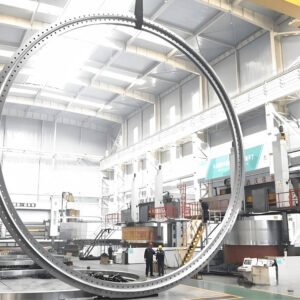
Equipped with 10,000‑ton‑class intelligent forging hydraulic presses, large ring rolling mills, and fully automatic heat treatment furnaces, capable of stable production of 5‑metre‑class large‑diameter flanges.
CMM, automated UT/MT inspection devices ensure dimensional accuracy and NDT capabilities at the industry forefront.
2) Process and quality
Over 10 years of experience in wind power flange manufacturing, mastering core processes such as Q355NE normalising + tempering, large‑size ring rolling, and heavy‑wall welding – with a 100 % pass rate for low‑temperature toughness.
Full quality traceability: each flange is supplied with material certificates, manufacturing records, and test reports, meeting the stringent requirements of offshore wind farm owners.
3) Customisation and delivery
Customise Q355NE flanges from φ1.2 m to 5 m outer diameter and 80–450 mm thickness per customer drawings; support special‑shaped and non‑standard designs.
Large‑scale production ensures short lead times; with marine‑grade anti‑corrosion packaging, we serve global offshore wind projects.
4) Cost and service
Direct supply from steel mills, plus large‑scale production, lowers costs – offering better value than imported alternatives.
We provide full lifecycle services: pre‑sales technical consulting, in‑process process optimisation, and post‑sales installation guidance.