42CrMo Drive Shaft for Mining Crushers, Conveyors & Excavators – Heavy-Duty Forged Transmission Shaft
The 42CrMo mining drive shaft is a core load‑bearing forged component used in heavy mining equipment for torque transmission, heavy‑duty support, and impact absorption.
Description
1. Introduction to 42CrMo Mining Drive Shafts
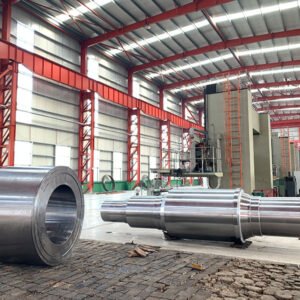
The 42CrMo mining drive shaft is a core load‑bearing forged component used in heavy mining equipment for torque transmission, heavy‑duty support, and impact absorption. Made from 42CrMo alloy structural steel, it is produced through ingot forging, heat treatment, and finish machining. Mining conditions—whether underground or open‑pit—are harsh, with constant alternating loads, heavy impacts, abrasive dust, vibration, and torsion. Ordinary carbon steel shafts tend to break, deform, or wear out prematurely. The 42CrMo forged shaft, thanks to its high strength and toughness, has become a key part of mining drive systems. Common configurations include solid straight shafts, stepped shafts, flanged shafts, and extended heavy‑load spindles. With a wide range of sizes, these are heavy‑duty open‑die forgings, mostly used in high‑power, high‑torque mining machinery.
2. Why 42CrMo is the Preferred Material for Mining Drive Shafts
2.1. Handles heavy loads without bending or twisting
With chromium and molybdenum additions, after quenching and tempering, 42CrMo achieves a tensile strength of over 1080 MPa and a yield strength of 885 MPa—significantly outperforming 45# or 40# carbon steels. Mining equipment runs at full load daily and endures sudden impact shocks; 42CrMo resists plastic deformation and torsional bending.
2.2. Good toughness, resistant to impact fracture
Underground conditions are dirty, with falling material impacts, frequent start‑stops, and overload lock‑ups. Shafts are subjected to alternating impact forces. 42CrMo has excellent low‑temperature impact toughness and does not easily become brittle even in sub‑zero environments. Under wet, cold conditions, fatigue cracks are less likely to initiate or propagate, greatly reducing shaft breakage accidents.
2.3. Uniform hardness in large forgings
Molybdenum improves hardenability, allowing large‑diameter shafts to be through‑hardened. There is little difference in hardness between the core and the surface, avoiding the “hard shell, soft core” problem. Overall load‑bearing capacity is stable, making the material reliable for large heavy‑duty shafts.
2.4. Wear‑resistant and long service life
After quenching and tempering plus surface hardening, the shaft achieves high surface hardness and good wear resistance. Its fatigue limit is also high, so under long‑term repeated torsion and bending, fatigue cracks are unlikely to appear. Compared with ordinary carbon steel shafts, service life is often 2‑3 times longer.
2.5. Maintains strength at high temperatures; resists moisture and corrosion
Underground environments contain water, slurry, and high humidity. Chromium provides inherent rust and corrosion resistance. During continuous operation with heat build‑up, 42CrMo retains its high‑temperature strength and does not rapidly soften or fail under elevated temperatures.
2.6. Easy to machine and repair
After forging, the material machines well for turning, milling, drilling, keyway cutting, and spline forming. After years of use, flanges or local wear can be weld‑repaired without much difficulty, which is friendly for mine maintenance and overhaul schedules.
3. Maximum Size Range for 42CrMo Mining Drive Shafts We Can Produce
Solid drive shafts
– Max. diameter: Φ1200mm
– Max. single‑piece overall length: 8500mm
– Max. single‑piece forging weight: 35 tons
Flanged / stepped heavy‑load drive shafts
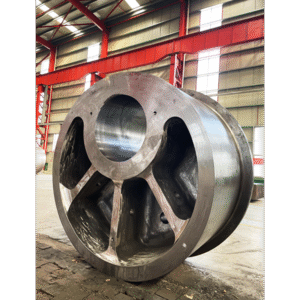
Flange outer diameter up to Φ1500mm; shaft body diameter within Φ1000mm; overall length up to 7800mm.
Hollow through‑hole drive shafts (customised on request)
Minimum inner hole Φ80mm; maximum outer diameter Φ900mm; overall length up to 6000mm.
4. Forging Process Flow for Large 42CrMo Mining Drive Shafts
Raw material inspection – Select national‑standard refined 42CrMo ingots; check chemical composition by spectrometer; use NDT to detect internal porosity, slag inclusions, and voids; reject substandard material.
Ingot heating – Use car‑bottom furnace with staged heating (low‑temperature preheat + high‑temperature soak); control heating rate to avoid cracking due to temperature differentials in large ingots; hold until adequate plasticity is achieved.
Open‑die rough forging – Use 10,000‑ton hydraulic press for upsetting and drawing out; break up internal porosity and shrinkages; densify the structure; eliminate casting defects; pre‑shape the blank.
Finish forging – According to the drawing, forge steps, flanges, shoulders, and transition sections in stages; leave machining allowance; ensure basic concentricity.
Post‑forge slow cooling and annealing – Cool slowly in a pit, then perform full annealing to relieve internal stress, refine grain size, reduce hardness for subsequent machining, and prevent cracking during rough turning.
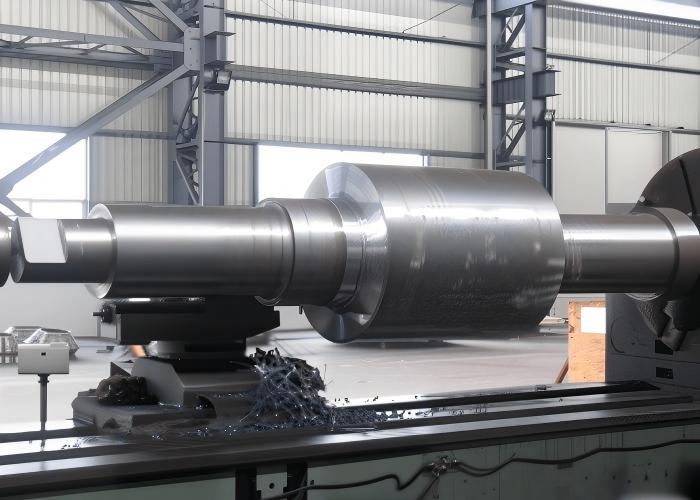
Rough machining – Turn on lathe to remove scale; rough‑turn shaft sections and flange diameters; leave allowance for quench‑and‑temper finishing.
Quenching and tempering (critical step) – Overall hardening plus high‑temperature tempering; precisely control quenching medium and tempering temperature to obtain uniform tempered sorbite structure, ensuring the forging meets the strength‑toughness balance required for heavy mining loads.
Non‑destructive testing – Ultrasonic testing (UT) for internal cracks and porosity; magnetic particle testing (MT) for surface defects; 100% inspection on large forgings to ensure no hidden flaws are shipped.
Finish machining – Precision turning, grinding, keyway/spline cutting, drilling, and flange face milling to meet dimensional tolerances, concentricity, and surface finish requirements.
Final inspection and warehousing – Retest mechanical properties (tensile, impact, hardness) from test coupons; recheck dimensions; issue material quality certificate, NDT reports, and heat treatment reports.
5. Which Mining Equipment Uses 42CrMo Drive Shaft Large Forgings?
5.1 Underground coal mining equipment
Scraper conveyor main shafts, stage loader reducer spindles, shearer traction shafts, hydraulic support drive spindles, belt conveyor drive drum shafts.
5.2 Open‑pit mining equipment
Heavy‑duty mining dump truck drive shafts, excavator travel spindles, crusher eccentric shafts, gyratory crusher main shafts, ball mill hollow shafts, rod mill drive spindles.
5.3 Tunnel boring equipment
Roadheader main shafts, belt transfer drive shafts, mine winch drive shafts, hoist reducer spindles.
5.4 Washing and beneficiation equipment
Vibrating screen eccentric shafts, magnetic separator main spindles, spiral washer drive shafts, heavy‑duty reducer input/output shafts.
5.5 Other underground heavy equipment
Mine hoist winches, endless rope winches, stage loader reducers, underground heavy gearbox spindles, and other drive components subjected to high torque and impact loads.
6. Our Strengths in Producing 42CrMo Mining Drive Shafts
6.1 Large forging equipment – capability for big parts
We have our own 10,000‑ton open‑die hydraulic press and large car‑bottom furnaces, capable of producing 42CrMo drive shaft forgings up to 35 tons. Many competitors cannot handle extra‑long or large‑diameter heavy spindles, but we can – and we accept single‑piece custom orders.
6.2 Strict inspection – peace of mind for mining applications
Incoming material is re‑checked by spectrometer. After forging, every piece undergoes 100% ultrasonic and magnetic particle testing. Each batch comes with tensile, impact, and hardness test reports, meeting mining equipment acceptance standards. We can also supply coal mine safety certification documentation.
6.3 Stable material quality – controlled from the source
We source 42CrMo ingots directly from major steel mills, keeping harmful impurities like sulfur and phosphorus at low levels, which reduces the risk of inclusions and cracks. Compared with forgings made from scrap re‑melted by small foundries, our products offer significantly longer fatigue life.
6.4 Custom drawings and one‑stop machining
Customers can provide 3D or 2D drawings; we can also reverse‑engineer from physical parts. From forged blanks through heat treatment, finish machining, and surface hardening – we handle everything in‑house. There is no need for customers to coordinate with multiple subcontractors, and overall lead time is shortened.