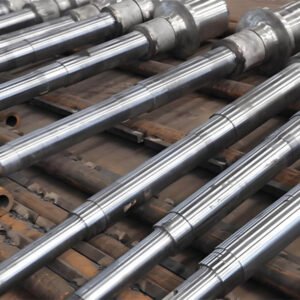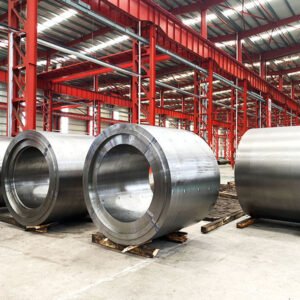
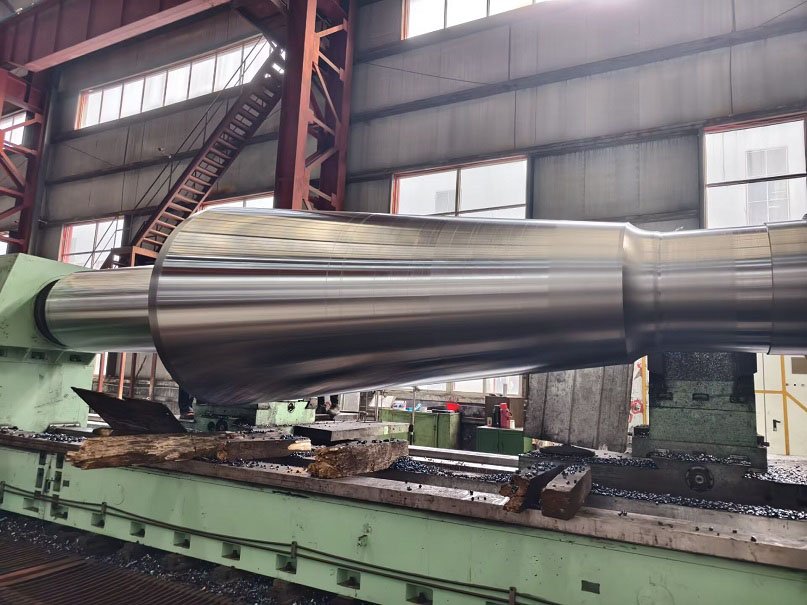
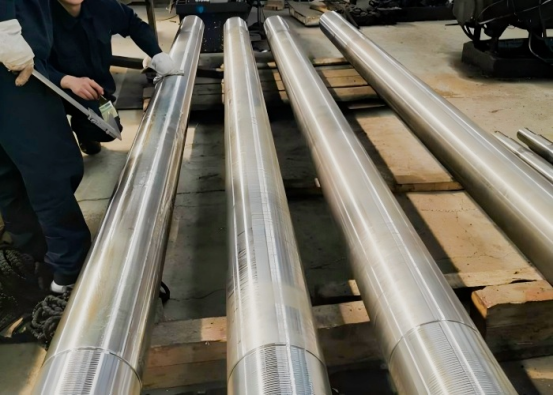
Custom Forged Steel Shaft for Mining Equipment OEM Heavy Duty Machined Shaft
Mining drive shafts are critical power transmission components in mining extraction, conveying, hoisting, and fully mechanized equipment.
Description
1. Brief Introduction to Mining Drive Shafts
Mining drive shafts are critical power transmission components in mining extraction, conveying, hoisting, and fully mechanized equipment. They are primarily used to transmit torque, power, and rotational speed, and are widely applied in scraper conveyors, stage loaders, hoists, crushers, roadheaders, and other mining equipment. These shafts operate continuously under severe conditions such as heavy loads, impact, dust, moisture, and alternating loads. They feature high strength, high toughness, impact resistance, wear resistance, fatigue resistance, and torsional resistance, with stable structure and long service life, making them key components for ensuring continuous operation of mining equipment.
2. Material Grades Commonly Used for Mining Drive Shafts
2.1 High-quality Carbon Structural Steel:
45#, 50#: Suitable for light-load, low-speed, conventional operating conditions – cost-effective, good machinability.
2.2 Alloy Structural Steel (Main materials):
40Cr: General-purpose grade, excellent comprehensive mechanical properties, balanced strength and toughness after quenching and tempering – first choice for general mining drive shafts.
42CrMo: High strength, high hardenability, fatigue resistance, impact resistance – widely used for heavy-load, high-speed main shafts and drive shafts under high impact loads.
35CrMo: Better toughness, strong torsional performance – suitable for hoisting equipment and large conveyor drive shafts.
20CrMnTi: Special grade for carburizing and quenching – high surface hardness with good core toughness – used for drive shafts with gears or splines.
2.3 High-strength Specialty Alloy Steel:
40CrNiMoA, 18Cr2Ni4WA: Ultra-high strength, resistance to heavy impact loads – used for large fully mechanized equipment, heavy-duty crushers, and other extreme operating conditions.
3. Core Technical Processes for Mining Drive Shafts
3.1 Billet preparation:
Firstly, suitable steel ingots or bars are picked and cut down. Then the material is moulded by either open-die forging or die forging which is done to disintegrate the as-cast structure, get rid of internal porosity and voids, and generally enhance density and fatigue performance.
3.2 Rough machining:
Rough turning and milling are done to take away the bulk of the material, set up the main external reference points, and get ready for heat-treatment.
3.3 Heat treatment (critical process)
Quenching and tempering (quenching + high-temperature tempering): It is a main method for producing uniform comprehensive mechanical properties, which also helps to increase torsional and fatigue resistance.
3.4 Surface hardening / carburizing and quenching:
Splines, journals, and mating surfaces are the parts of the shaft that are usually carburized and quenched so as to get higher surface hardness and better wear resistance.
3.5 Stress-relief annealing:
This is done to remove the internal stresses caused by forging and machining so as to avoid any later changes in shape or cracking.
3.6 Precision machining:
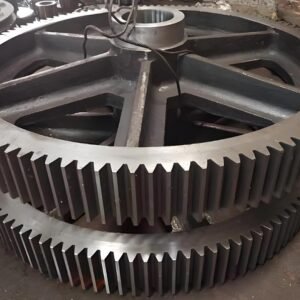
Besides CNC turning and grinding, gear hobbing / spline cutting are also employed. It is a very stringent control of factors like coaxiality, circular runout, dimensional tolerances, and surface finish that is made in order to guarantee assembly accuracy.
3.7 Surface strengthening treatment:
Different methods such as high-frequency hardening, phosphating, blackening, chrome plating, etc., are used for journals to not only increase wear resistance but also rust preventive and anti-galling properties.
3.8 Straightening process:
After finish machining, the shaft will be straightened to keep bending deformation within limits and thus smooth running is guaranteed.
4. Size Range of Mining Drive Shafts TIPTOP FORGING Can Supply
Diameter range: Φ20 mm – Φ650 mm
Length range: 100 mm – 8000 mm
Capable of machining plain shafts, stepped shafts, splined shafts, gear shafts, hollow drive shafts, and various other structures. Supports customization of short shafts and extra-long heavy-duty mining drive shafts.
5. TIPTOP FORGING’s Advantages in Producing Mining Drive Shafts
Strict Material Selection: Raw materials from reputable large mills, traceable material sources. Appropriate steel grades are matched according to customer requirements and different mining conditions.
Integrated Forging + Heat Treatment: In-house forging and heat treatment production lines ensure uniform microstructure, outstanding impact resistance, torsion resistance, and fatigue resistance – minimizing risk of shaft fracture or deformation.
High Machining Precision: Full set of CNC machining equipment and precision grinding machines – strict compliance with geometric tolerances such as coaxiality and runout – resulting in low noise and low wear during operation.
Full-Process Quality Control: Step-by-step inspection from raw material incoming to finished product dispatch – eliminating defects – suitable for continuous high-intensity mining operations.
Strong Customization Capability: Supports standard parts and non-standard custom machining according to drawings. Process parameters and hardness can be adjusted based on operating conditions. Single-piece trial production and batch production both accepted.
Comprehensive Product Range: Capable of producing drive shafts for conveyors, hoists, roadheaders, crushers, and other mining equipment – one-stop supply.
6. What Non-Destructive Testing (NDT) Methods Can TIPTOP FORGING Provide for Drive Shafts?
UT: Detects internal defects such as cracks, shrinkage cavities, inclusions, and laminations – covers full-body inspection of the shaft.
MT: Focuses on surface and near-surface cracks on journals, steps, splines, fillets, etc. – detects fatigue cracks and quench cracks.
PT: Suitable for complex shapes where MT is inconvenient – detects fine surface-opening cracks.
Hardness Testing: Brinell, Rockwell, or Vickers hardness testing to verify that heat treatment process requirements are met.
Metallographic Examination: Sample inspection of microstructure to assess forging and heat treatment quality.