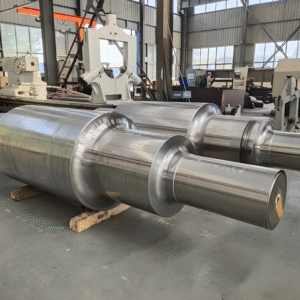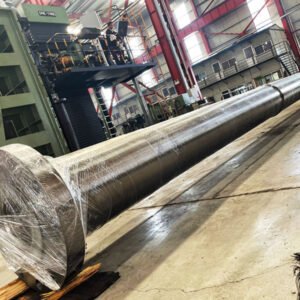
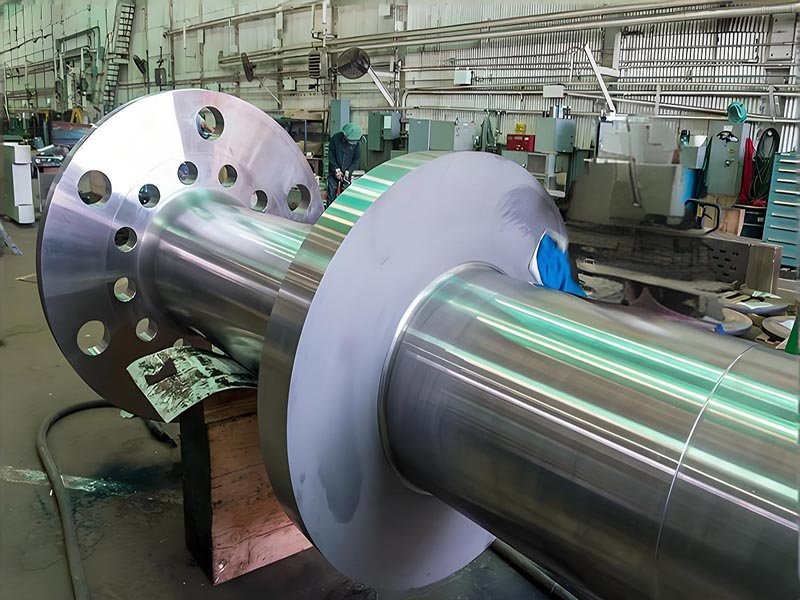
40CrNi Marine Shaft Forgings for Ship Propulsion Systems
During operation, marine shaft forgings are subjected to complex combined loads such as torsion, bending, impact, and long-term seawater corrosion. Therefore, their material quality, forging process, and inspection standards directly determine the safety, reliability, and service life of the vessel.
Description
40CrNi marine shaft forgings are major parts of ship propelling systems, which are employed for transferring the power from the engine to the propeller. Such forgings are, e.g., intermediate shafts, propeller shafts, stern shafts, rudder stocks, and crankshafts.
When working, marine shaft forgings face a variety of combined loadings including torsion, bending, impact, plus long-term exposure to seawater corrosion. Hence, the raw material quality, the manufacturing process, and the standard of final checks are their factors that will directly address the safety, reliability, and duration of the ship’s running.
We are a team that focuses on delivering reliable marine shaft forgings that meet international standards and classification society’s rules and are able to support commercial shipping, offshore engineering, and special vessels.
Roles and Marine Environment of Marine Shaft Forgings
Marine shaft forgings are the most important parts that bear the load of propulsion mechanisms. Essentially, they pass the energy from the engine to the propeller along with maintaining their alignment and ensuring structural stiffness.
Practically in marine conditions, such parts have to perform under:
- Uninterrupted torsion forces due to power transmission
- Bending stress as a result of shaft misalignment and hull deformation
- Impact forces from propeller operation
- Corrosion due to seawater and marine atmosphere
With these very tough service conditions, excellent strength, toughness, fatigue resistance, and corrosion resistance will be needed.
Material Options for Marine Shaft Systems
Material selection depends on vessel type, operating environment, and classification requirements.
Carbon Structural Steel
Typical grades: 20, 35, 45
Suitable for general-purpose shaft components with moderate strength requirements.
Alloy Structural Steel (Mainstream Choice)
- 40Cr
- 40CrNi
- 38CrMoAl
Among these, 40CrNi shaft forgings are widely used due to their high strength, good toughness, and excellent fatigue resistance, making them suitable for heavy-duty marine shaft systems.
Low-Temperature and High-Strength Steel
- 17Mn1Si
- 20Mn
Used in cold-region vessels or structures requiring enhanced impact resistance.
Stainless and Corrosion-Resistant Materials
- 2Cr13
- 0Cr18Ni10Ti
Applied in environments with high corrosion risks or special seawater exposure conditions.
Manufacturing Standards and Classification Certification
Our marine shaft forgings are manufactured in strict accordance with international standards and classification society rules.
- Chemical composition: GOST 1050–2013, GOST 4543–2016
- Mechanical properties: GOST 8479–70
- General forging requirements: GOST 7062–90
Products can be certified by major classification societies upon request, including:
- CCS (China Classification Society)
- ABS (American Bureau of Shipping)
- DNV (Det Norske Veritas)
- LR (Lloyd’s Register)
- NK (ClassNK)
This ensures full compliance with global marine engineering requirements.
Technical Specifications and Quality Control
The chemical composition of each forging batch is strictly analyzed to ensure compliance with material standards.
Mechanical properties such as tensile strength, yield strength, elongation, and impact energy are tested according to classification requirements.
Typical hardness ranges include:
- HB 123–167
- HB 143–179
- HB 179–229
Forgings undergo heat treatment processes such as:
- Normalizing
- Normalizing + tempering
- Quenching + tempering
Macrostructure must be free from defects such as:
- White spots
- Porosity
- Shrinkage cavities
- Cracks and segregation
Non-destructive testing includes ultrasonic testing (UT) and magnetic particle testing (MT) to ensure internal quality meets classification standards.
Supply Condition and Traceability
All marine shaft forgings are supplied in heat-treated condition.
Available delivery states include:
- As-forged
- Rough machined
- Semi-finished
- Fully machined
Each product is delivered with complete documentation:
- Material certificate
- Heat treatment report
- Non-destructive testing report
- Classification society certificate
All forgings are clearly marked with heat number, part number, and serial number to ensure full traceability.
Applications in Marine and Offshore Engineering
Our marine shaft forgings are widely used in:
Commercial Vessels
- Bulk carriers
- Oil tankers
- Container ships
- Ro-ro passenger vessels
Offshore Engineering
- Drilling platforms
- Offshore support vessels
Specialized Ships
- Icebreakers
- Research vessels
- Naval ships
They are suitable for both diesel propulsion systems and electric propulsion shaft lines.
Why Choose 40CrNi for Marine Shaft Forgings
40CrNi is one of the most commonly used materials for marine shaft systems due to its balanced performance:
- High strength and toughness
- Good hardenability for large-section forgings
- Excellent fatigue resistance under cyclic loading
- Stable performance under marine working conditions
Compared with carbon steels, 40CrNi provides improved reliability and longer service life in heavy-duty propulsion systems.
Product Specifications Table
| Item | Specification |
| Material | 40CrNi / 40Cr / 38CrMoAl |
| Product Type | Shaft forgings |
| Process | Open die forging + heat treatment |
| Heat Treatment | Normalizing / Q&T |
| Hardness | HB 123–229 |
| Standards | GOST / Classification Society |
| Inspection | UT / MT |
| Certification | CCS / ABS / DNV / LR / NK |
| Delivery | Rough / Machined |
FAQ – Marine Shaft Forgings
What are marine shaft forgings used for?
They are used in ship propulsion systems to transmit torque from the engine to the propeller.
Why use 40CrNi for shaft forgings?
40CrNi offers high strength, good toughness, and excellent fatigue resistance, making it ideal for marine environments.
What inspections are required for marine shaft forgings?
Ultrasonic testing and magnetic particle testing are commonly required to ensure internal and surface quality.
Can you provide classification society certification?
Yes, products can be certified by CCS, ABS, DNV, LR, and other classification societies.
Contact and Custom Marine Forging Solutions
We provide customized marine shaft forgings based on drawings, material requirements, and classification standards. Contact us for technical support and detailed quotations.