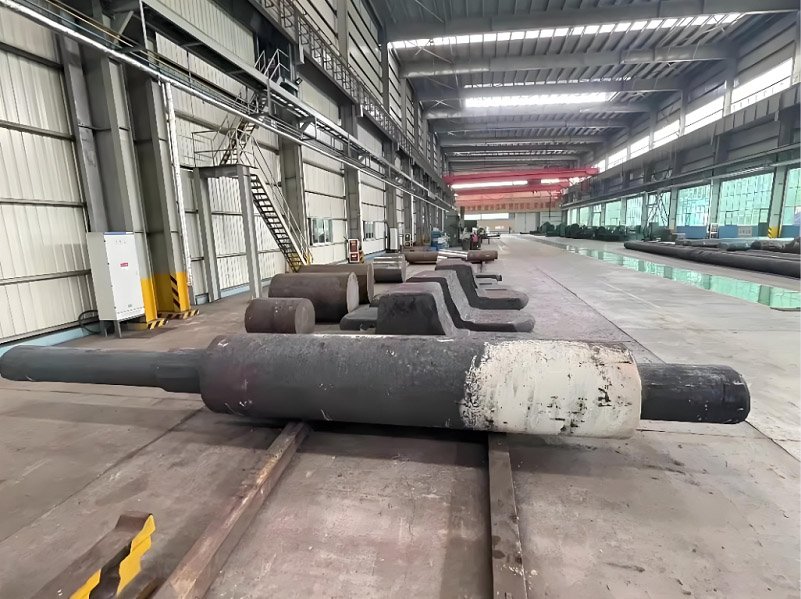
34CrNiMo6 Marine Low-Speed Diesel Engine Crankshaft Forgings Supplier
Description
Marine Low-Speed Diesel Engine Crankshaft Forgings – What Are They?
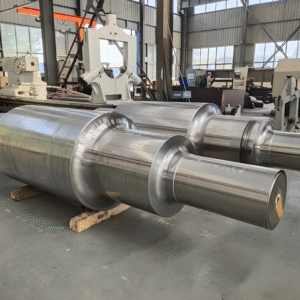
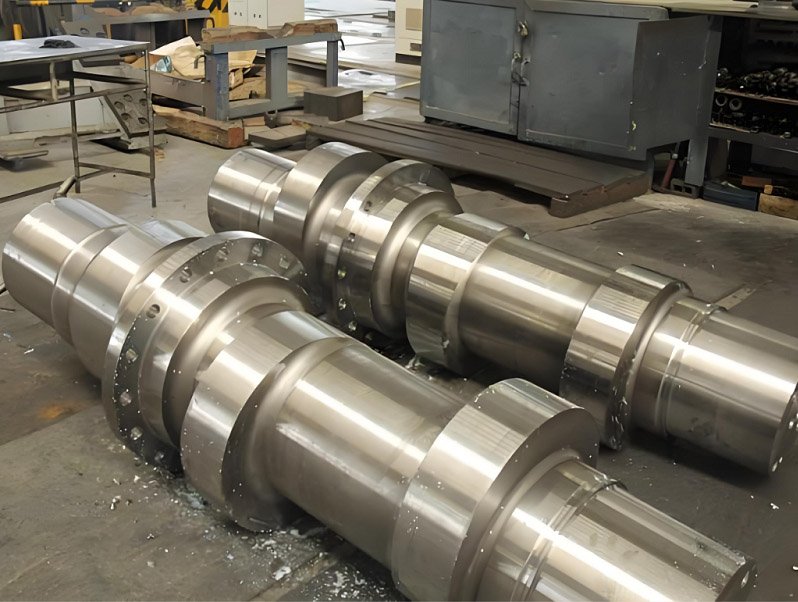
The crankshaft is the engine component that literally makes things move in marine low-speed diesel engines. It takes the pistons’ reciprocating motion and transforms it into rotational power, which subsequently powers the ship’s propeller.
In addition to their enormous size—crankshafts for ocean-going vessels may be longer than 10 meters—these components are also subjected to prolonged heavy load conditions. This is why crankshaft forgings remain one of the most challenging components to produce in the entire engine assembly.
Even minor internal flaws or dimensional errors may pose significant risks to operation. For this reason, forged crankshafts, especially those manufactured from high-grade alloy steels such as 34CrNiMo6, are very popular for critical marine applications.
The Significance of Forged Crankshafts in Marine Engines
The engine of a ship is continually subjected to high stress including high torque, cyclic loadings, plus long periods of operation. Given a situation like this, the internal integrity of the crankshaft is valued above everything else.
Forged crankshafts, in contrast to cast ones, present:
- A tighter and more consistent internal structure
- Superior fatigue resistance and lowered crack propagation
- Greatest safety and integrity in the presence of long-term changing loads
From the perspective of shipowners and engine manufacturers, this means a significant reduction in breakdowns, extended intervals between overhauls, and overall decrease in lifecycle costs.
Material Options for Marine Crankshaft Forgings
Choosing the right material is the foundation of performance.
34CrNiMo6 Alloy Steel for Heavy-Duty Marine Applications
34CrNiMo6 is one of the most commonly used materials for large crankshaft forgings. It combines high strength with good toughness, making it suitable for components subjected to dynamic and impact loads.
Alternative Materials Based on Different Requirements
Depending on design and operating conditions, other materials may also be selected:
- 42CrMo – for higher strength requirements
- 35CrMo – for balanced performance and machinability
- S34MnV – for large-section forgings requiring good toughness
Custom alloy solutions are also available when specific standards or classification society requirements need to be met.
How Marine Crankshaft Forgings Are Manufactured
Producing a large marine crankshaft is not a single process—it’s a combination of controlled steps where each stage affects the final quality.
Steelmaking and Ingot Quality Control
The process starts with high-purity steel produced through refining technologies such as LF, VD, or ESR. This step is critical for minimizing impurities and ensuring internal cleanliness.
Heavy Forging on Large-Capacity Presses
Forging is carried out using high-capacity presses (typically over 10,000 tons). The goal is to refine the grain structure and eliminate internal defects through sufficient deformation.
Key forming steps include:
- Upsetting and drawing to shape the main journals
- Offset forging to form the crank throws
- Precision shaping of flange ends and transition zones
Heat Treatment for Strength and Stability
After forging, controlled heat treatment is applied to improve mechanical properties:
- Normalizing and tempering to refine grain structure
- Isothermal annealing when improved machinability is required
- Final quenching and tempering for strength and toughness
Machining and Dimensional Control
Given the size and complexity, machining is performed in stages:
- Rough machining to prepare for heat treatment
- Semi-finishing and finishing of journals and crankpins
- Strict control of roundness, cylindricity, and surface roughness
Non-Destructive Testing (NDT)
Inspection is carried out throughout the process:
- 100% ultrasonic testing (UT) for internal defects
- Magnetic particle testing (MT) for surface cracks
All inspections are performed according to international standards such as GB/T 6402 or EN 10228-3.
What Makes 34CrNiMo6 Crankshaft Forgings a Reliable Choice
For marine applications, reliability is not optional—it’s expected.
34CrNiMo6 crankshaft forgings are widely recognized because they offer:
- Consistent performance under cyclic loading
- Strong resistance to fatigue failure
- Stable mechanical properties after heat treatment
- Long service life in harsh marine environments
When combined with proper forging and quality control, these advantages become even more evident in large engine applications.
Typical Applications
34CrNiMo6 marine crankshaft forgings are commonly used in:
- Low-speed diesel engines for container ships and bulk carriers
- Marine power generation systems
- Offshore and heavy-duty shipbuilding projects
Looking for a Reliable Marine Crankshaft Forging Supplier?
Choosing a supplier for large crankshaft forgings is not just about price—it’s about consistency, process control, and the ability to handle complex projects.
At TIPTOP Forging, we focus on:
- Stable raw material sourcing and refining processes
- Experience in manufacturing large and complex forgings
- Strict quality inspection throughout production
- Custom solutions based on your technical drawings and requirements
If you are sourcing 34CrNiMo6 marine crankshaft forgings or evaluating new suppliers, feel free to share your specifications or project details.
We’re ready to support you with practical solutions and reliable manufacturing.