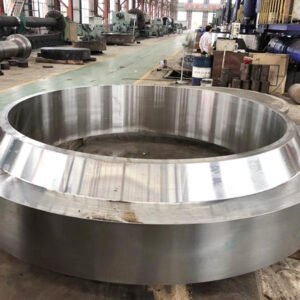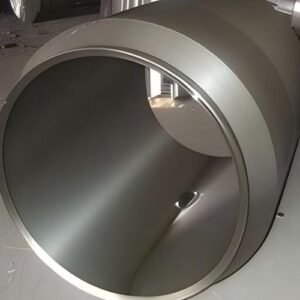
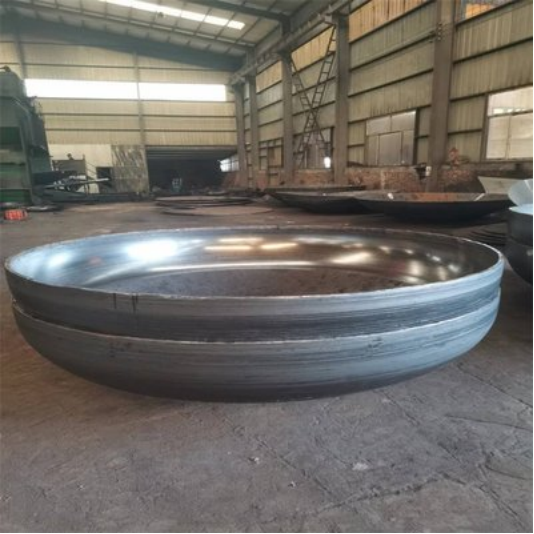
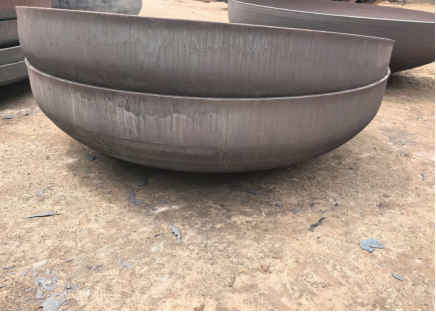
Q345R Custom Ellipsoidal head for pressure vessel
A pressure vessel head is sometimes referred to as an end cover or closure. It is a key pressure-bearing part of the pressure vessel. It is primarily welded to the two ends of the cylindrical shell, providing sealing as well as pressure-bearing functions, and at the same time, enclosing a complete pressure-containing volume.
Description
1. Introduction to Pressure Vessel Heads
A pressure vessel head is sometimes referred to as an end cover or closure. It is a key pressure-bearing part of the pressure vessel. It is primarily welded to the two ends of the cylindrical shell, providing sealing as well as pressure-bearing functions, and at the same time, enclosing a complete pressure-containing volume. The head and the shell together resist medium pressure, temperature, loads, and other operating conditions. Its forming quality, mechanical properties, and dimensional accuracy have a great impact on the total safety and service life of the pressure vessel. It finds its applications in storage tanks, reactors, heat exchangers, boilers, and other equipment in chemical, petroleum, power, food, pharmaceutical and HVAC industries.
2. Common Materials for Pressure Vessel Heads
- Carbon structural steel: Q245R, Q235B – mostly used for ordinary pressure vessels at room temperature.
- Low-alloy heat-resistant / high-strength steel: Q345R, Q355R, 16MnDR, 15CrMoR – suitable for medium-high pressure, low-temperature, and high-temperature equipment.
- Stainless steel: 304, 316L, 321 – widely used in chemical, food, pharmaceutical, and other corrosive media conditions.
- Other special materials: Duplex stainless steel, aluminum alloy, titanium alloy, Monel alloy – used for strong corrosion, high-purity media, lightweight, and other special conditions.
3. Dimensional Range of Pressure Vessel Heads We Can Manufacture
(Values can be replaced based on actual production capacity and equipment parameters; general reference version provided)
- Nominal diameter: DN150mm ~ DN8000mm
- Plate thickness: 3mm ~ 120mm
- Maximum single-piece weight: up to 80 tons
- Applicable shells: Compatible with atmospheric, low-pressure, medium-pressure, and high-pressure pressure vessel shells. Supports custom conventional and extra-large diameter non-standard heads.
4. Heat Treatment Processes for Pressure Vessel Heads
After stamping, spinning, cutting, and welding, heads develop work hardening and residual stresses. Heat treatment is required to relieve stress and restore mechanical properties. Common processes include:
4.1 Stress relief annealing (heat treatment stress relief)
It is a most common method to be used for heads that are cold-formed and welded. Removing residual stamping and welding stresses is one of its positive impacts. Besides, such kinds of deformations and cracking will not happen in the future. Generally, the heat is maintained for a long time at a low temperature and the object is slowly cooled afterwards.
4.2 Normalizing
Can be regarded as a major method to be used for heads with thick walls and heads made of high-strength alloy steel, grain refining, microstructure homogenization, and overall mechanical property and toughness enhancement.
4.3 Normalizing + tempering
For the purpose of manufacturing high-pressure, high-temperature, thick-wall pressure-bearing heads, this combination of methods helps to further stabilize the microstructure, reduce hardness, improve plasticity, and maintain long-term operational stability.
4.4 Solution treatment
Mainly for stainless steel heads. By this treatment, cold work hardening will be completely removed, corrosion resistance and plasticity can be restored, and service performance can be guaranteed.
5. Classification of Pressure Vessel Heads (by shape)
- Elliptical head – Most widely used, uniform stress distribution, strong pressure-bearing capacity, aesthetically pleasing. First choice for general-purpose pressure vessels.
- Dished head – Composed of a spherical section, transition segment, and straight flange. Easier to form, moderate cost, mostly used for medium-low pressure storage tanks and conventional vessels.
- Spherical head (hemispherical head) – Best pressure-bearing performance, requires the thinnest wall thickness under the same pressure, saves material, mostly used for high-pressure and ultra-high-pressure pressure vessels.
- Conical head – Divided into non-flanged and flanged types, mainly used for material flow guidance, discharge, and diameter transition. Commonly found in hoppers and lower sections of reactors.
- Flat head – Simplest structure, lowest processing cost, poor pressure-bearing performance, only suitable for atmospheric and low-pressure small-diameter equipment, manholes, and blind flanges.
- Domed head (spherical dome / shallow dished head) – Simple structure, often used for atmospheric tanks and pipe end closures.
6. Advantages of Our Pressure Vessel Head Manufacturing
6.1 Full-category production capability
We can manufacture all types of conventional and special shapes of heads such as elliptical, dished, spherical, conical, and flat heads. Our materials include carbon steel, alloy steel, stainless steel of all grades, and special alloys, which can fulfill the customized demands of various industries.
6.2 Wide dimensional coverage, extra-large parts available
Proven forming technology for large-diameter, thick-wall heads, exceeding conventional size limits. Supports non-standard, extra-large, and heavy-tonnage custom heads.
6.3 Comprehensive heat treatment system
Equipped with professional heat treatment furnaces, capable of performing full processes such as stress relief annealing, normalizing, and solution treatment. Strictly controls residual stress to ensure mechanical properties.
6.4 Advanced processes and equipment
Uses multiple forming techniques including spinning, die stamping, cold forming, and hot forming. CNC machining ensures dimensional accuracy, roundness, and straight flange height. Standardized welding and bevel processing.
6.5 Compliant quality system
Holds relevant pressure vessel head production qualifications. Full-process non-destructive testing, material inspection, and dimensional inspection. Products meet national and industry pressure equipment standards; complete quality documentation provided.
6.6 Delivery and service advantages
In-house production lines with ample capacity and stable delivery times. Supports drawing customization and on-site technical coordination. Provides one-stop services including head processing, beveling, anti-corrosion treatment, and pre-assembly.
6.7 Cost-effective
Mass production and mature technologies keep the cost of factory equipment at a resonable level,whilestill ensuring the quality. Competitive pricing for both standard and non-standard parts.