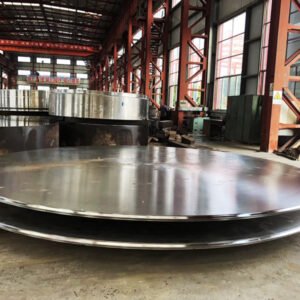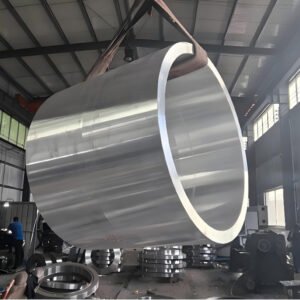
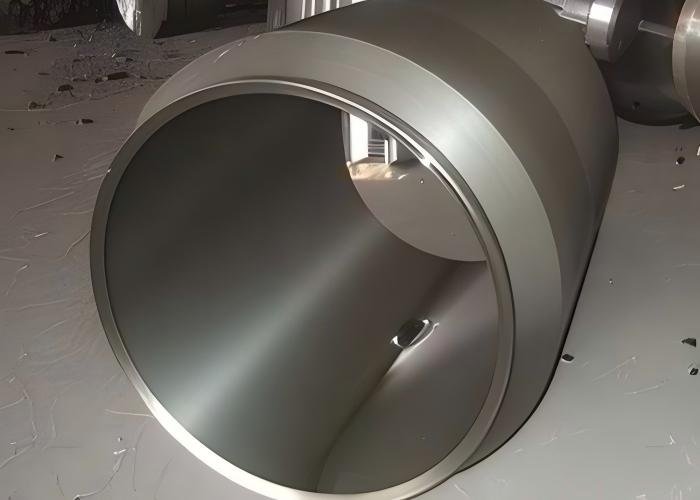
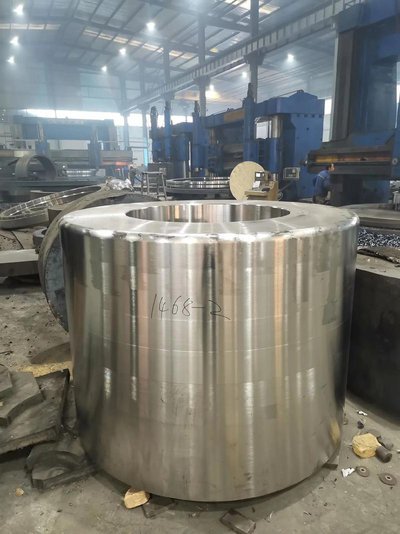
ASME SA-266 Large-Diameter Pressure Vessel Shell Forging
Pressure vessel shell forgings are primarily used in high-pressure, medium-to-high temperature, and corrosive service conditions, including applications such as hydrogenation reactors, gasifiers, gas storage tanks, heat exchangers, nuclear reactor pressure vessels, hydrotreating units, and high-pressure piping reactors.
Description
1. Introduction to Pressure Vessel Shell Forgings
Pressure vessel shell forgings are the primary load-bearing forged components of pressure equipment. They are produced from steel ingots via open-die forging or cylindrical forging, forming seamless one-piece ring-shaped cylindrical forgings—distinct from steel plate welded shells. They are primarily used in high-pressure, medium-to-high temperature, and corrosive service conditions, including applications such as hydrogenation reactors, gasifiers, gas storage tanks, heat exchangers, nuclear reactor pressure vessels, hydrotreating units, and high-pressure piping reactors.
2. Common Materials for Pressure Vessel Shells
2.1 Ambient-Temperature Low-Pressure Carbon Steels
20, 20Mn – Suitable for low-pressure, non-corrosive applications at ambient temperature. Low cost, but limited to low-pressure service.
2.2 Medium-Temperature, Medium-to-High-Pressure Low-Alloy Heat-Resistant Steels (Mainstream in Petrochemical Hydrogenation)
16MnDR, 15CrMo, 12Cr1MoV, 14Cr1MoR, 2.25Cr-1Mo, 2.25Cr-1Mo-0.25V (Cr-Mo-V steel specially used for hydrogenation reactors).
2.3 Low-Temperature Pressure Vessel Steels
09MnNiDR, 16MnDR, 3.5%Ni, 5%Ni, 9%Ni steel
2.4 Special Corrosion-Resistant / Nuclear-Grade Steels
Stainless steels: 304, 316L, 321 stainless steel shell forgings
Nuclear-grade: SA508 Gr.2, Gr.3, Gr.4N nuclear shell forgings.
High-strength hydrogen-resistant special alloy steels and duplex stainless steel forgings.
3. Pressure Vessel Size Range We Can Produce
Minimum inner diameter: φ300 mm
Maximum inner diameter: φ6500 mm
Shell wall thickness: 80 mm – 600 mm
Effective single-piece shell length: 500 mm – 12000 mm
Single forging weight: 0.5 t – 180 t
4. Key Forging Processes for Pressure Vessel Shell Forgings
4.1 Piercing (Mandrel Piercing)
A central through-hole is pierced in the solid steel ingot to form a hollow blank – the basic step for shell forming. Eccentricity must be controlled to ensure uniform wall thickness.
Mandrel Forging (Core Operation)
The mandrel is pushed through the piece then shell wall will be compressed many times in between the upper and lower anvils while at the same time widening the inner diameter,decreasing the wall thickness and making the shell longer.This refines the grain structure, compacts internal voids and porosity, and significantly improves density and mechanical properties.
4.2 Reaming (Bar Reaming)
For large-diameter cylinders, a bar supports the inner bore while rolling the outer wall to enlarge the inner diameter, ensuring uniform wall thickness, correcting roundness, and reducing cylinder ovality.
4.3 Post-Forging Heat Treatment (Preparatory Heat Treatment)
Normalizing / Annealing / Tempering to eliminate forging stresses, refine the forged microstructure, and prepare for subsequent quenching and tempering as well as non-destructive testing.
4.4 Final Quenching and Tempering Heat Treatment
Quenching + high-temperature tempering– to achieve the required combination of strength, plasticity, and low-temperature impact toughness, meeting the mechanical property requirements for pressure vessels.
4.5 Finish Machining + Non-Destructive Testing (NDT)
Internal and external diameter turning, end face machining; UT (ultrasonic testing), MT (magnetic particle testing), PT (penetrant testing) – with defect classification according to specified standards.
5. Classification of Forging Grades for Pressure Vessel Shell Forgings – Which Grade Should Be Selected?
Steel forgings for pressure equipment are classified into four grades: Ⅰ, Ⅱ, Ⅲ, and Ⅳ. The grading is based on equipment category, design pressure, temperature, forging thickness, NDT extent, and mechanical testing requirements:
Grade Ⅰ forgings: Only visual inspection and dimensional check; no NDT and no separate mechanical testing. Permitted only for non-critical low-pressure small parts under atmospheric or very low pressure. Not permitted for shells.
Grade Ⅱ forgings: Mechanical properties tested per batch using sampled specimens; partial NDT. Suitable for non-critical small parts in low-pressure Class I pressure vessels.
Grade Ⅲ forgings: Mechanical properties tested on each piece; 100% surface NDT (MT/PT), with UT at critical areas. Suitable for conventional shells in medium-to-high-pressure Class I and Class II pressure vessels.
Grade Ⅳ forgings: Mechanical properties and low-temperature impact tests on each piece; 100% UT + 100% MT + 100% PT full NDT; plus metallographic examination, inclusion rating, and grain size verification. Required for Class III high-pressure vessels, hydrogenation, nuclear, hydrogen service, low-temperature, and heavy-wall shells.
Industry mandatory requirement: Since the pressure vessel shell is the primary load-bearing component, Grades Ⅰ and Ⅱ forgings are strictly prohibited for shell supply.
6. Our Company’s Advantages in Producing Pressure Vessel Shell Forgings
6.1 Large-size capability: We can produce shells up to 6500 mm inner diameter and 180 t single weight, covering the full size range for petrochemical, coal chemical, LNG low-temperature, and nuclear applications – with outstanding capacity for large-tonnage, large-diameter shells compared to peers.
6.2 Proven expertise in special materials: We have mastered forging processes for Cr-Mo hydrogenation steels, 9%Ni low-temperature steels, SA508 nuclear-grade steels, and stainless steel shells, overcoming industry pain points such as cracking, grain coarsening, and low-temperature impact failures in high-alloy steels. We supply in volume to major refining and energy companies.
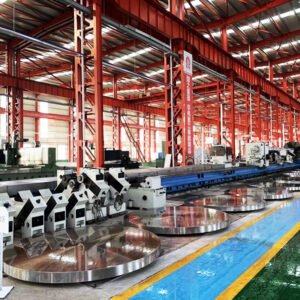
6.3 Comprehensive heat treatment and inspection systems: Equipped with large-capacity car-bottom heat treatment furnaces capable of quenching and tempering entire shell bodies. We have fully automated ultrasonic testing, magnetic particle, and penetrant inspection equipment, plus a third-party-accredited NDT laboratory that can issue special equipment–recognized inspection reports, meeting supervision and factory release requirements.
6.4 Strict forging grade control: All shells are produced to at least Grade Ⅲ standards; high-pressure hydrogen service units are uniformly executed to Grade Ⅳ standards. We retain samples from each piece for mechanical testing and provide complete material quality certificates, heat treatment curves, and NDT reports, fully compliant with special equipment supervision requirements.
6.5 Integrated processing and delivery – one-stop service: Equipped with large CNC horizontal lathes and floor-type boring mills, we can supply finished machined shells directly, including flange sealing faces, bevels, and nozzle steps. Customers can directly weld and assemble upon receipt, reducing secondary processing costs and lead time.
6.6 Reliable delivery and after-sales support: We are a long-term supplier to leading domestic petrochemical, new energy, and equipment manufacturers, with stable mass-production delivery schedules. We also provide technical support for forging process planning, material selection, heat treatment, and full supervision tracking throughout the manufacturing process.