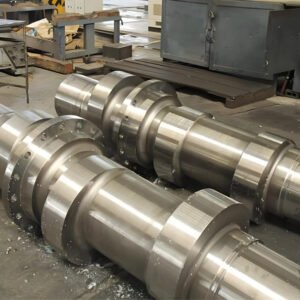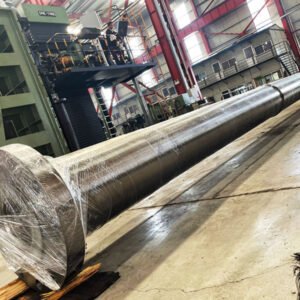
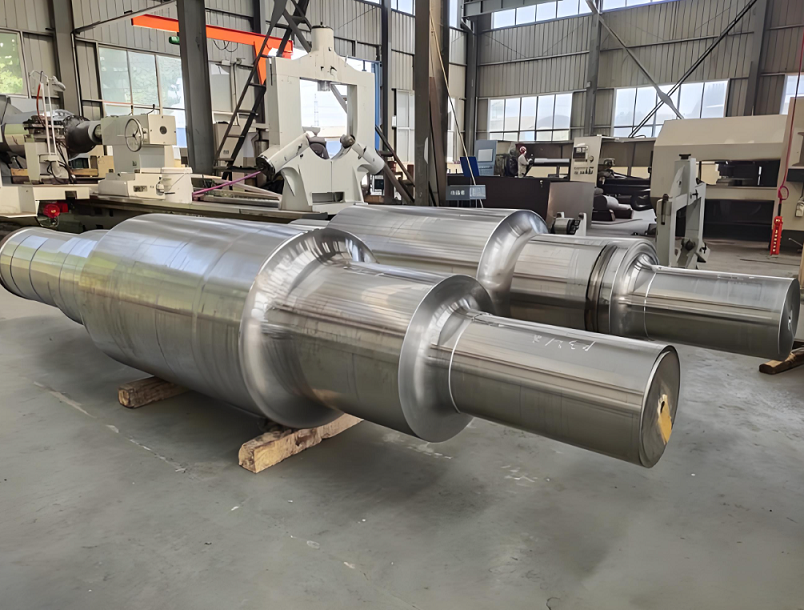
Large-Sized Intermediate Shaft Forgings For Marine Propulsion and Heavy-Duty Transmission
Large-scale intermediate shaft forgings are core power transmission components in marine propulsion systems, wind turbine generators, and large-scale mining machinery. They are responsible for torque transmission, withstand complex alternating loads including torsion, bending, and impact, and ensure the stable operation of equipment. As a key hub between the power input end and the working end, such shafts impose extremely high requirements on internal density, stability of mechanical properties, and dimensional accuracy. Manufactured via step-by-step forging processes, large-tonnage forging equipment and precision heat treatment technologies, these shafts can maintain uniform microstructure and reliable long-term working performance even in deep-sea environments or severe working conditions.
Description
Large-Sized Intermediate Shaft Forgings For Marine Propulsion and Heavy-Duty Transmission
Product Introduction
Large-scale intermediate shaft forgings are core power transmission components in marine propulsion systems, wind turbine generators, and large-scale mining machinery. They are responsible for torque transmission, withstand complex alternating loads including torsion, bending, and impact, and ensure the stable operation of equipment. As a key hub between the power input end and the working end, such shafts impose extremely high requirements on internal density, stability of mechanical properties, and dimensional accuracy. Manufactured via step-by-step forging processes, large-tonnage forging equipment and precision heat treatment technologies, these shafts can maintain uniform microstructure and reliable long-term working performance even in deep-sea environments or severe working conditions.
Company Forging Capabilities
Our company specializes in integrated manufacturing of large forgings, establishing a full-process production system covering steel ingot smelting, forging, heat treatment, precision machining, and final inspection.
Core Forging Equipment:
Core forging equipment includes large-tonnage presses (12,500t, 8,000t, and 15,000t hydraulic presses) and 5t/8t electro-hydraulic hammers, capable of producing forgings up to 120 tons; advanced heat treatment is performed in a 7.5×7.5×21m truck-mounted furnace ensuring uniform temperature and consistent microstructure; precision machining is supported by deep hole boring machines, horizontal/vertical lathes, and a CMM; and the professional technical team covers expertise in design, material selection, forging, heat treatment, and precision machining.
Applications
Marine and Offshore Engineering
Tail shafts, intermediate shafts, thrust shafts, rudder stocks, and propeller shafts for various ocean-going vessels.
Wind Power Generation
Main shafts, gearbox shafts, bearing shafts, and other drivetrain components for onshore and offshore wind turbines.
Mining and Heavy Machinery
Main shafts for large gyratory crushers, mill drive shafts, and rotary axes for large excavators.
Other Industries
– Power Equipment: Turbine rotor shafts, generator shafts, and hydro-turbine main shafts.
– Metallurgical Equipment: Large work rolls and support rolls.
– Petrochemical Industry: Pressure vessel shells and cylinder forgings.
Product Specification Range
Large-sized intermediate shaft forgings can be custom-produced according to customer drawings and technical requirements. The main specification parameters are as follows:
| Parameter | Specification Range |
| Max. Single Piece Weight | ≤120 tons (marine intermediate shafts up to >100 tons) |
| Max. Outer Diameter | Ø2500 mm |
| Max. Shaft Body Outer Diameter | Ø3000 mm |
| Max. Length | 18,000 mm |
| Finish Machining Accuracy | Dimensional accuracy: IT7 or above; Coaxiality / Cylindricity ≤0.03 mm/m |
| Surface Roughness | Ra ≤3.2 μm |
Core Technology and Processes
(1) Smelting: We use electric furnace + LF refining + VD vacuum degassing (max vacuum level <133 Pa) to get rid of gas and inclusions, so we can make sure the steel ingot is super pure, y’know?
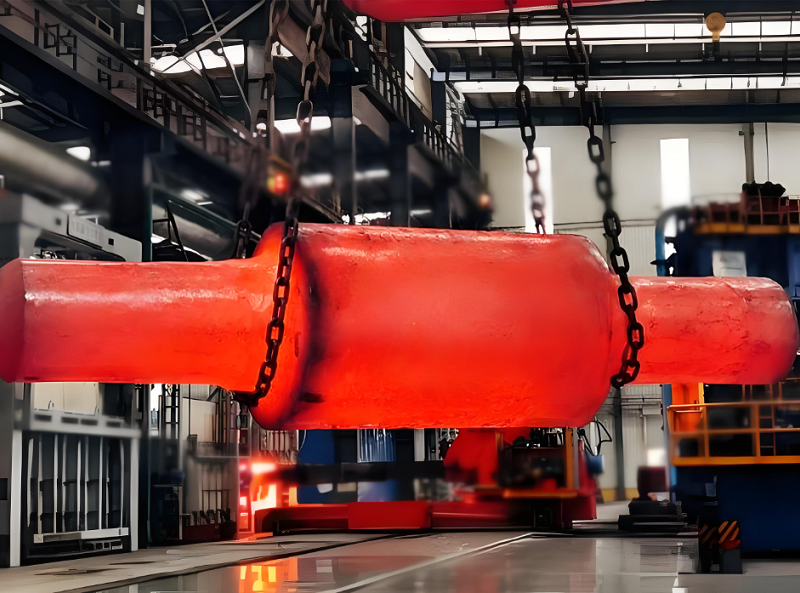
(2) Forging: For marine shaft products, the forging ratio needs to be ≥3:1—for high-end stuff it’s gotta be ≥4.5, and it can go all the way up to 6:1. The starting forging temp is kept between 1100–1180℃, and the final forging temp has to be at least 850℃. We do multi-direction step forging: upsetting → drawing out/punching → expanding → final shaping. In every heating step, the deformation is strictly kept between 30-50% to stop cracks from popping up.
(3) Heat treatment: After forging, we do slow cooling or isothermal annealing at around 600℃ to get rid of internal stress and refine the grain structure. For quenching: we heat it up to 840–860℃, holding time is calculated based on effective thickness, it’s 1.8–2.5 min per mm. For tempering: hold it at 580–650℃ for 3–6 hours, then cool it down fast to avoid temper brittleness.
Product Advantages
- High material purity and reliable internal quality
Utilizing a triple refining process of vacuum refining + LF + VD, we strictly control the content of harmful elements such as hydrogen, oxygen, sulfur, and phosphorus in the steel. Non-metallic inclusions are controlled to ≤ Grade 1.5 for all A/B/C/D types, ensuring high internal density from the source and eliminating metallurgical defects such as inclusions, porosity, and shrinkage cavities.
- Uniform and dense microstructure with excellent grain size
By precisely controlling the forging ratio (≥3:1 to 6:1) and employing multi-directional forging processes, we ensure uniform microstructure across the entire cross-section of the shaft. Grain size meets or exceeds ISO 643 Grade 5, with key sections achieving ASTM Grades 6–8, significantly enhancing fatigue resistance and service life.
- High dimensional accuracy and minimal machining allowance
Using CNC radial forging machines for near-net-shape forming, combined with precision CNC lathes and external cylindrical grinders for finishing, machining allowances are kept within optimal ranges. The surface finish is clean and consistent, with dimensional accuracy exceeding IT7 grade, greatly reducing material waste and lowering subsequent machining costs.
4. Excellent overall mechanical properties
After quenching and tempering treatment, the forged shaft achieves an excellent balance between high strength and high toughness.
- Full-process traceability and premium service
We implement comprehensive quality control throughout the entire process—from ingot smelting, forging, heat treatment to precision machining. Each product leaving the factory comes with complete documentation, including material certificates, heat treatment process curves, non-destructive testing reports, and dimensional inspection reports.
Inspection System
(1) Chemical composition and impurity analysis
Spectrometers and ONH2000 gas analyzers are used for smelting analysis and finished product analysis. According to ASTM, ISO and GB/T standards, the alloy components such as C, Cr, Mn, Ni, Mo, and the impurity contents such as S, P, H, and O are tested.
(2) Mechanical property testing
According to GB/T 228.1-2021 and other standards, all mechanical property indicators must comply with the corresponding specifications or customer drawings.
(3) Non-destructive testing (NDT)
Ultrasonic testing (UT)
Magnetic particle testing (MT)
Penetrant testing (PT)
(4) Dimension and form tolerance testing
All inspections must be strictly conducted in accordance with customer drawings and ISO/GB/T standards.
(5) Metallographic structure and grain size testing
Using an Olympus inverted metallographic microscope (equipped with image analysis software), the grain size level (4-12 grades) is determined according to ASTM E112-13 standards. Non-metallic inclusions are evaluated according to ISO 4967 standards to ensure uniformity and purity of the structure.
(6) Factory Documentation System
All qualified products come with a complete set of factory technical documentation.