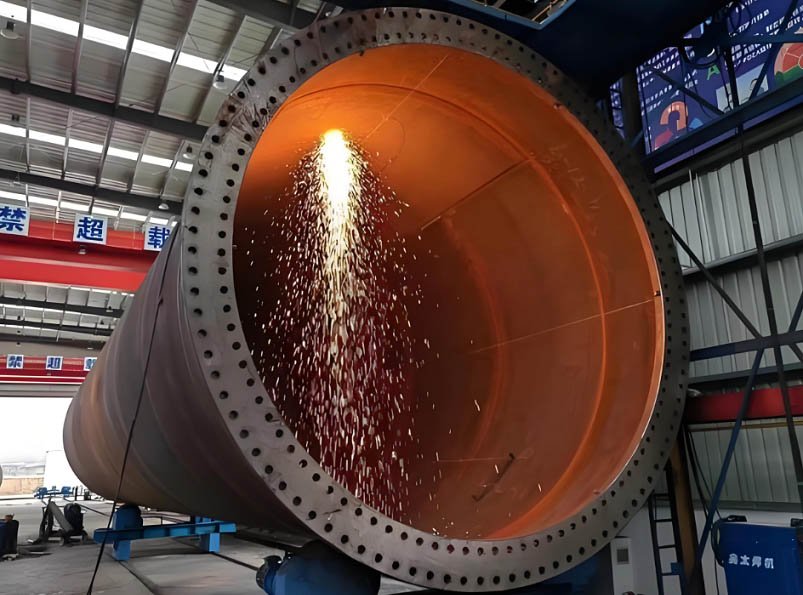
Q345E Tower Flange Forgings for Wind Turbines
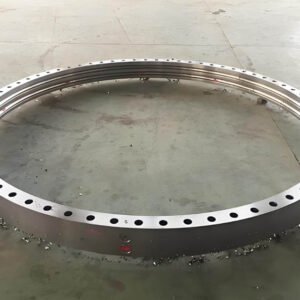
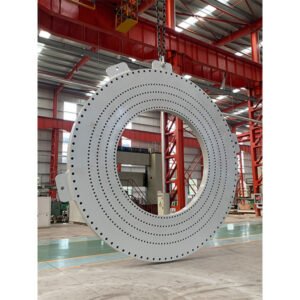
As the main connecting parts between tower sections, tower flanges are the ‘joints’ of a wind turbine. Their dependability has a direct impact on the overall structural stability, safety, and lifespan of the entire system. Particularly, for large turbines over 100 meters in height, performing flanges will be a priority when dealing with strong winds, changing loads, and low temperatures.
Description
What Are Tower Flange Forgings in Wind Turbines?
Whether situated on vast grasslands or offshore wind farms, wind turbines are capable of functioning non-stop in challenging environmental conditions, changing natural wind energy into clean energy. Behind these enormous structures, tower flange forgings play a pivotal role.
As the main connecting parts between tower sections, tower flanges are the ‘joints’ of a wind turbine. Their dependability has a direct impact on the overall structural stability, safety, and lifespan of the entire system. Particularly, for large turbines over 100 meters in height, performing flanges will be a priority when dealing with strong winds, changing loads, and low temperatures.
Materials Used for Wind Tower Flange Forgings
Low-Alloy High-Strength Steel (Q345E / S355NL)
Q345E and S355NL are still common choices for making wind tower flange components due to their excellent combination of strength and low-temperature toughness. These steels are mainly used in conditions that can go down to -40°C
level without compromising their mechanical properties, preventing any kind of sudden failure at very low temperatures.
Customized Weathering Steel Options
Weathering steel can be tailored to meet the needs of an offshore or a highly-corrosive environment project. Such a choice helps resisting corrosion while at the same time decreasing maintenance costs over a long period of time.
Advanced Steel Refining Process (LF + VD)
Almost all incoming materials go through the following treatments:
- Ladle Furnace (LF) refining,
- Vacuum Degassing (VD).
These treatments critically enhance steel purity and chemical uniformity. After delivery, the materials are re-checked by heat number. In addition, the third-party inspection can be arranged if necessary.
Tower Flange Forging Manufacturing Process
Step 1 – Billet Cutting and Controlled Heating
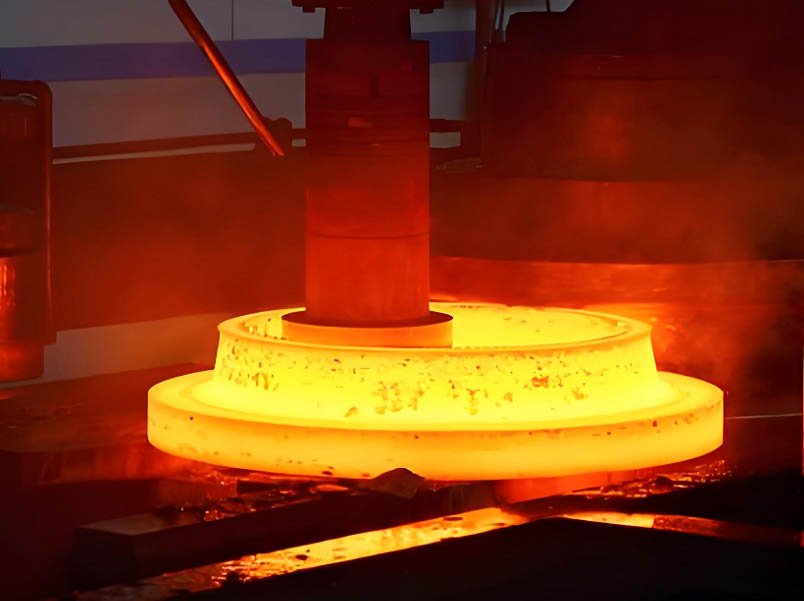
Raw materials are precisely cut using large-scale sawing equipment and then heated in a controlled furnace. The temperature is strictly maintained between 1230°C – 1250°C, ensuring uniform heating and optimal forging conditions.
Step 2 – Precision Forging and Ring Rolling
Forging and Blooming
The billet undergoes repeated upsetting and elongation using high-capacity hydraulic presses (over 5,000 tons). The forging ratio is controlled at ≥ 3.5, and can reach 6–10 depending on specifications.
This process:
Eliminates internal porosity
Refines grain structure
Forms continuous metal flow lines
CNC Ring Rolling (D53K Series)
Advanced radial-axial ring rolling machines are used to achieve precise forming of large-diameter flanges. This ensures:
High dimensional accuracy
Uniform internal structure
Improved load-bearing capacity
Step 3 – Strengthening and Toughening Heat Treatment
Heat treatment is essential for achieving the required mechanical properties.
Segmented Heating
Slow heating below 650°C reduces thermal stress
Rapid heating above 650°C refines grain structure
Controlled Cooling
Air cooling or water spray cooling is applied
Prevents undesirable phase formation
Achieves an optimal ferrite-pearlite structure
This process significantly enhances both strength and toughness compared to conventional normalizing.
Step 4 – CNC Machining and Quality Inspection
Precision Machining
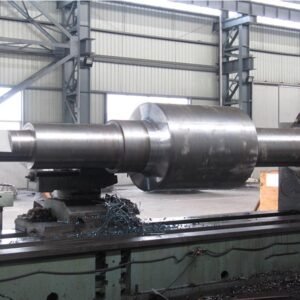
5-meter CNC vertical lathes ensure accurate turning of inner/outer diameters and flange faces
CNC drilling machines guarantee precise bolt hole positioning
Non-Destructive Testing (NDT)
100% ultrasonic testing (UT)
Magnetic particle testing (MT)
In compliance with NB/T 47013
Mechanical Testing
Tensile strength
Yield strength
Impact testing at -40°C
Quality Standards and Inspection for Tower Flanges
Dimensional Standards
Manufactured according to JB/T 11218-2020 and relevant project specifications.
Strict Quality Control
From raw materials to final inspection, each step is monitored and recorded to ensure consistency and reliability.
Full Traceability System
Each flange forging is assigned a unique identification number, allowing full traceability of:
Raw materials
Process parameters
Inspection records
Key Advantages of Q345E Tower Flange Forgings
Excellent Low-Temperature Performance
Maintains strong toughness and impact resistance at temperatures as low as -40°C, suitable for extreme climates.
High Strength and Fatigue Resistance
Optimized forging ratio and heat treatment improve structural integrity and extend service life.
High Dimensional Accuracy
CNC ring rolling and precision machining ensure tight tolerances and easy on-site assembly.
High Material Purity
Advanced refining processes minimize internal defects and improve long-term reliability.
Full Traceability
Complete documentation ensures quality transparency and project confidence.
Why Choose Our Wind Tower Flange Forgings
We focus on delivering reliable large-scale forged components for demanding applications. With strict control over materials, forging processes, and inspection standards, we ensure every tower flange meets real-world operating requirements.
Whether for onshore or offshore wind projects, our flange forgings are designed to provide consistent performance, long service life, and dependable structural support.
FAQ About Tower Flange Forgings
What is the typical forging ratio for tower flanges?
The forging ratio is generally controlled at ≥ 3.5, and can be increased to 6–10 for higher-performance requirements.
Why is Q345E suitable for low-temperature environments?
Q345E offers excellent impact toughness at low temperatures, making it suitable for environments down to -40°C.
What testing methods are used for flange forgings?
Common testing includes:
Ultrasonic Testing (UT)
Magnetic Particle Testing (MT)
Tensile and impact testing
Can you manufacture large-diameter tower flanges?
Yes, we can produce customized large-diameter flange forgings using advanced ring rolling and machining equipment.
Conclusion
Choosing high-quality tower flange forgings means ensuring the long-term safety and performance of your wind turbine system. With reliable materials, controlled manufacturing processes, and strict quality inspection, our Q345E tower flange forgings provide a dependable solution for modern wind energy projects.