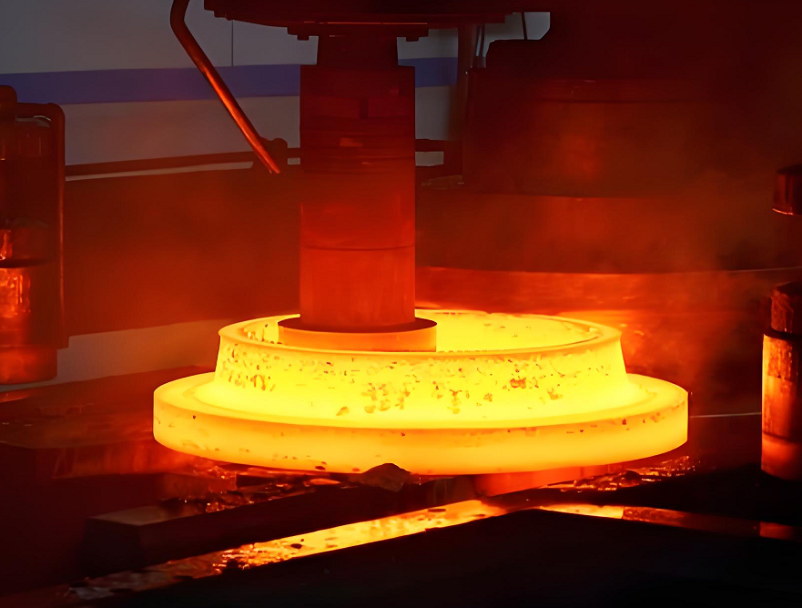
ASTM A182 High-Pressure Forged Flange Forgings For Oil and Gas Industry
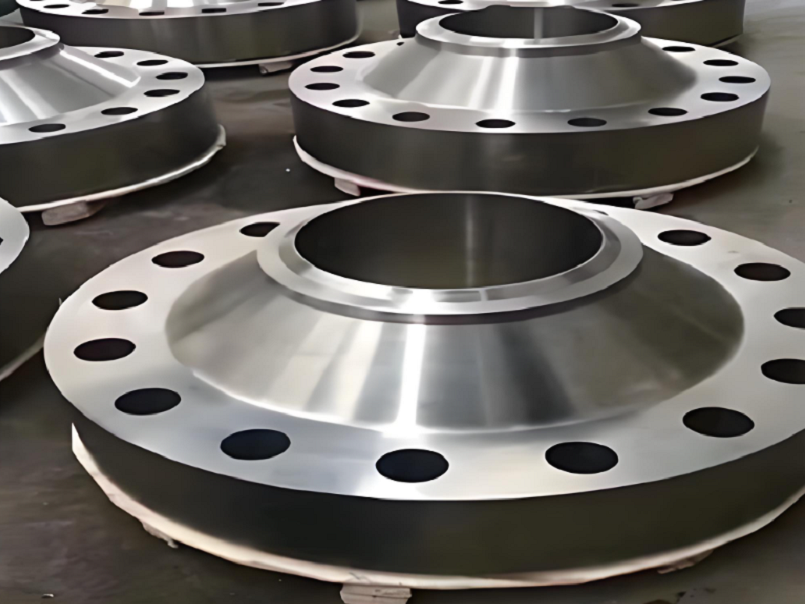
High-pressure forged flanges are high-performance components made via forging, used to connect pipes, valves, and pumps in high-pressure systems. They achieve a tight seal through plastic deformation of gaskets (e.g., oval, octagonal, or lens gaskets).
Description
ASTM A182 High-Pressure Forged Flange Forgings For Oil and Gas Industry
Product Introduction
High-pressure forged flanges are high-performance components made via forging, used to connect pipes, valves, and pumps in high-pressure systems. They achieve a tight seal through plastic deformation of gaskets (e.g., oval, octagonal, or lens gaskets).
Common Materials
The main materials of high-pressure forged flanges are divided into three categories, which can be selected according to the pipeline medium, operating temperature and pressure requirements:
1.Carbon Steel
Grades: ASTM A105, 20#, Q235, 16Mn, A350 LF1/LF2/LF3, A694 F42–F70
- Stainless Steel
Grades: ASTM A182 F304/304L, F316/316L, 1Cr18Ni9Ti, 0Cr18Ni9Ti, 321
- Alloy Steel
Grades: ASTM A182 F1/F5a/F9/F11/F12/F22/F91, 16MnR, Cr5Mo, WC5/WC9, C5/C12
Special Materials (e.g., titanium alloy) are available for highly corrosive environments.
Forging Standards
High-pressure forged flanges comply with key domestic and international standards:
International Standards:
– ASTM A694/A694M – Carbon/alloy steel forgings for high-pressure transmission (grades F42–F70)
– ASTM A182/A182M – Forged alloy/stainless steel flanges for high-temperature service
– ASME B16.5 – Dimensional standard for steel pipe flanges (Class150–Class2500)
Forging Process
Basic Forging Process Flow
The complete production process of high-pressure forged flanges includes key links: blanking → heating → forming → post-forging cooling → heat treatment → finish machining → non-destructive testing. According to the mass of forgings and production batch, forging methods are mainly divided into three types: open-die forging, closed-die forging and loose tooling forging.
Our Company’s Core Forging Advantages
- 1. Advanced Multi-Directional Closed-Die Forging Technology
Our company adopts multi-directional closed-die forging technology, which realizes efficient material flow and microstructure homogenization through multi-axis loading, which can significantly improve flange performance, reduce manufacturing costs and shorten production cycles. The combined process of “radial extrusion + axial closed-die forging” accurately controls the equivalent plastic strain deviation in all directions to ≤ 15%, effectively avoiding cracks caused by local overload. Multi-directional forging can form three-dimensional compressive stress, eliminate as-cast porosity, and achieve a density of over 99.9%.
2. Full-Process Precision Temperature Control
Our company implements a multi-stage gradient heating process (e.g., 650℃×2h → 850℃×2h → 1180℃×3h), ensuring that the temperature difference between the core and surface of the billet is less than 30℃. High-precision temperature control can effectively avoid cracking during heating and realize optimized regulation of material microstructure.
3. Intelligent Production Management System
Our company realizes intelligent control of the entire production process through an advanced automated forging production line. Each link from blanking, forging, heat treatment to machining can be accurately traced, effectively ensuring product consistency and stability.
4. Full-Chain One-Stop Service Capability
Our company has one-stop forging processing service capabilities including mold design and manufacturing, forging, ring rolling, heat treatment and precision machining, and can provide complete solutions from blanks to finished products, and from standard specifications to non-standard customization.
5. All-Round Testing Guarantee
Equipped with sophisticated testing equipment including direct-reading optical emission spectroscopy, ultrasonic testing, magnetic particle testing, radiographic testing and metallographic analysis, we can conduct full-process quality monitoring for each product to ensure no internal cracks or defects.
Our Company’s Forgeable Size Range
Our company’s high-pressure forged flanges cover a wide processing size range, fully meeting the requirements of various working conditions:
Nominal Diameter (DN): DN15 ~ DN3000, covering a large caliber range from 1/2 inch to 120 inches.
Pressure Rating: Class150 ~ Class2500 (PN2.0 ~ PN42.0), meeting the requirements of different pressure working conditions.
Wall Thickness Range: 12mm ~ 58mm.
Extra-Large Size Capability: Large-diameter flanges can be processed up to the extra-large caliber of DN3000.
Customized Service: We support comprehensive customized services of size, material and sealing surface type (raised face RF, male and female face M/FM, tongue and groove face T/G, ring joint face RJ, etc.) according to customers’ specific working condition requirements.
What Are the Advantages of High-Pressure Forged Flanges?
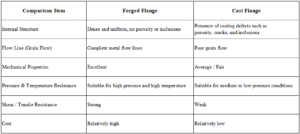
By virtue of the unique advantages of forging process, high-pressure forged flanges are significantly superior to cast flanges in many aspects:
1. Excellent Mechanical Properties
Forging improves the internal grain structure of metal through plastic deformation, eliminates defects such as pores and porosity in raw materials, endowing the material with higher strength, toughness and fatigue resistance. For our company’s DN1800 flange forgings, the tensile strength can reach over 600MPa, and the yield strength is not less than 400MPa. The comprehensive mechanical properties of forgings including tensile strength, toughness, hardness and fatigue durability are all significantly improved.
2. Dense Internal Microstructure
Forging solves the problems of segregation and porosity, making the material structure more compact. Forged flanges generally contain lower carbon than cast flanges, are less prone to rust, have good metal streamline and dense microstructure. The internal structure is uniform, with no harmful defects such as pores, cracks and inclusions existing in castings.
3. Reliable Sealing Performance
Forged steel flanges have good flatness and smoothness, which can ensure the sealing performance when connected with pipes or equipment and reduce the risk of leakage. The sealing surface is processed by a precision grinding machine with low surface roughness. Cooperating with high-precision sealing gaskets, the sealing pressure can reach 10~30MPa, meeting the sealing requirements of different working conditions.
4. Outstanding High-Pressure and High-Temperature Resistance
Forged flanges have good pressure and temperature resistance, and are generally suitable for high-temperature and high-pressure working environments, withstanding a maximum high temperature of 800℃ and ultra-high pressure working conditions above PN40MPa.
5. Long Service Life
Excellent fatigue resistance and impact resistance enable it to remain stable during long-term operation, effectively resisting the impact of external pressure and vibration. There is no weld at the connection between the flange and the pipe, avoiding weld fatigue, stress concentration and leakage risk, improving the bearing capacity and service life.
6. Comparative Advantages vs Cast Flanges
7. Good Corrosion Resistance
Forged flanges have low carbon content and are not easy to rust. Combined with the selection of stainless steel or alloy steel materials, they have excellent corrosion resistance. For high-corrosion environments such as offshore platforms, special materials such as duplex stainless steel 2205 can be selected with a cathodic protection system.