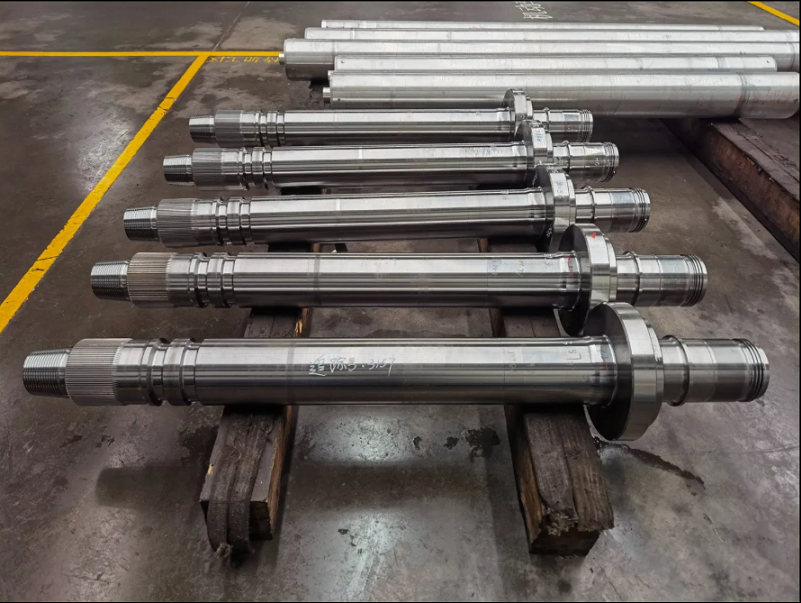
AISI 4340 Top Drive Shaft Forging in Oil Drilling
The AISI4340 top drive transmission shaft forging is the core power transmission and load-bearing component of the top drive drilling system of oil drilling rigs
Description
AISI 4340 Top Drive Shaft Forging in Oil Drilling
Product Overview of AISI 4340 Top Drive Shaft Forging in Oil Drilling
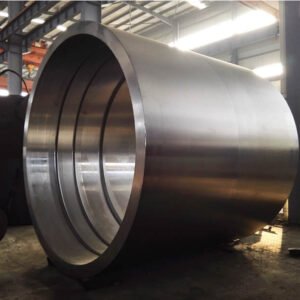
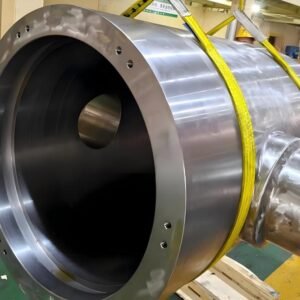
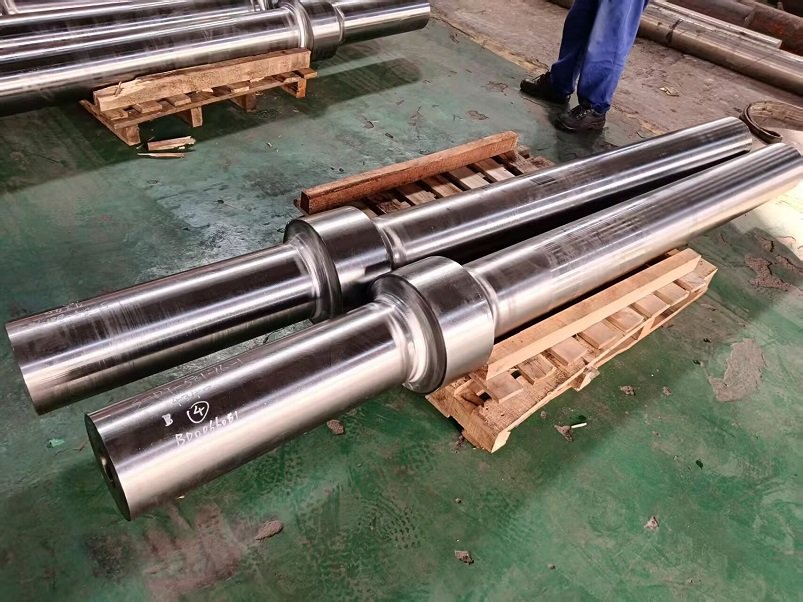
The AISI4340 top drive transmission shaft forging is the core power transmission and load-bearing component of the top drive drilling system of oil drilling rigs. It is forged as a single piece, integrating the main shaft, connection flange, transmission spline, etc. It is designed to withstand high torsional forces, alternating bending loads, and impact loads for a long time. It is suitable for deep well, ultra-deep well, and complex geological drilling conditions, responsible for transmitting the power of the main unit to drive the drill string to rotate for drilling. It possesses comprehensive performance such as high load-bearing capacity, fatigue resistance, strong impact resistance, and resistance to harsh medium erosion. It is the key load-bearing forging component for the safe and stable operation of the top drive equipment.
The basis of the standard is API 7K, 6A drilling equipment specifications, ASTM A370 mechanical performance standards, ASTM A388 ultrasonic testing standards for forged parts, ASTM E45 non-metallic inclusions rating, GB/T 31049 general standard for top drive devices, and AISI 4340 American standard alloy structural steel execution standards.
Material advantages – Why choose 4340
Chemical composition is controlled according to the AISI 4340 standard ratio, strictly controlling harmful impurities:
C: 0.38 – 0.43%
Si: 0.15 – 0.35%
Mn: 0.60 – 0.90%
Ni: 1.65 – 2.00%
Cr: 0.70 – 0.90%
Mo: 0.20 – 0.30%
S ≤ 0.015%
P ≤ 0.020%
The ratio of nickel-chromium-molybdenum alloy, with high strength while retaining low-temperature impact toughness, does not crack or deform in low-temperature and cold drilling environments. Nickel is the key characteristic that distinguishes 4340 from other steel grades such as 4145 – the 1.65% to 2.00% nickel content endows this material with excellent quenching and low-temperature impact toughness, enabling it to still achieve uniform hardened layers on large-section forgings; chromium enhances the material’s corrosion resistance and wear resistance; molybdenum strengthens the temper stability and inhibits temper brittleness. This design of the nickel-chromium-molybdenum alloy system enables 4340 to achieve a delicate balance between quenching property, toughness and strength, significantly outperforming equivalent alloy structural steels such as 4145.
Anti-hydrogen sulfide (H₂S) performance
After precise quenching and tempering treatment and hydrogen removal aging process, AISI4340 has its hardness strictly controlled within a reasonable range. The hardness is usually required to be ≤ 22 HRC, effectively inhibiting sulfide stress cracking (SSC) and hydrogen-induced cracking. Compared with ordinary carbon steel and low-alloy shaft-type steel, its corrosion resistance to oilfield sulfur-containing mud and medium erosion has significantly improved. It can be adapted to drilling conditions of medium and low sulfur oil and gas wells. When combined with surface protection technology, the lifespan of anti-sulfur and anti-corrosion performance can be further enhanced.
Mechanical properties and core technical indicators
Tensile strength Rm: ≥ 1100 MPa
Yield strength Re: ≥ 930 MPa
Post-fracture elongation A: ≥ 13%
Cross-sectional contraction rate Z: ≥ 55%
Low-temperature impact energy (-20℃) Akv: ≥ 60 J
Quenching and tempering hardness: HRC 30 – 36 (HB 285 – 340)
Grain size: 7 – 8 grades, structure is uniform sorbite
Forging and Heat Treatment Process of AISI 4340 Top Drive Shaft Forging in Oil Drilling
Forging Process
The raw materials are selected as high-quality and refined steel ingots to ensure the compactness of the billet body;
Segmented gradient heating, strictly controlling the forging temperature within 1160~1190℃, to prevent overburning and overheating;
Overall drawing + precision forging forming, the forging ratio of the core stressed parts is ≥ 5, the metal flow lines are distributed along the axial direction of the transmission shaft completely, without interruption or disorder;
The final forging temperature is strictly controlled at above 800℃, after forging, it is slowly cooled in a slow cooling pit to release the internal stress of forging and prevent the blank from deforming and cracking;
The finished blank is straightened and processed, the straightness is strictly controlled to meet the industry standard.
Heat Treatment Process
The final mechanical properties of 4340 forgings depend on the control level of the quenching and tempering heat treatment process. The core process parameters are as follows:
Quenching: Heat to 830℃~860℃ for austenitization, fully heat up and then quench in oil; for complex-shaped or large-section forgings, a dual-medium quenching process of water quenching and oil cooling can be adopted, taking into account both the quenching depth and crack risk control.
Tempering: After quenching, it should be tempered immediately (to avoid cracking caused by quenching stress), the tempering temperature is adjusted within the range of 540℃~660℃ according to the target strength grade. The general tempering temperature is about 600℃; if higher strength (about 45 HRC) is required, a low-temperature tempering – 340℃~360℃- can be adopted followed by 44-440℃. The tempering holding time is calculated as 1~2 hours per 25 mm section, and then cooled in the air. Special attention should be paid to avoiding tempering in the brittle zone of 250℃~450℃ to prevent a significant drop in impact toughness.
In addition, before quenching and tempering, the forgings should undergo normalizing or annealing pre-treatment (normalizing temperature about 815℃~860℃), to refine the grains, homogenize the structure, and provide a good organizational basis for the final quenching and tempering.
Non-destructive Testing (NDT) and Quality Control for AISI 4340 Top Drive Shaft Forging in Oil Drilling
100% Ultrasonic UT Inspection: Whole shaft body inspection, without internal shrinkage, porosity, voids, or cracks, meeting the first-grade forging inspection standard;
Magnetic Particle MT Surface Inspection: Full coverage inspection of the shaft shoulders, round corners, and keyway roots in high-stress areas, eliminating surface micro-cracks;
Each batch of forgings is sampled according to standards for tensile, impact, and hardness tests to verify whether the mechanical properties meet the design requirements. Metallographic examination is used to evaluate grain size, non-metallic inclusions level, and microstructure state.
Product Specifications and Application Scope of AISI 4340 Top Drive Shaft Forging in Oil Drilling
Specification Range
Customizable various large, medium, and small top drive transmission shaft forgings, outer diameter φ80mm~φ600mm, total length 300mm~6000mm, supporting customizations of solid shafts, hollow shafts, flange integral shafts, and keyway transmission shafts with various shapes, and non-standard production according to drawings, dimensions, and torque parameters.
Typical Applications
Full series of top drive transmission systems for land-based oil drilling rigs, vehicle-mounted drilling rigs;
Main transmission shafts for deep wells, ultra-deep wells, drilling equipment in mountainous and cold regions;
Main transmission shafts for oil well workover rigs, heavy-duty transmission shafts for downhole operations;
Heavy-duty transmission shafts for large mines, heavy-duty power transmission shafts for construction machinery.
What are the production advantages of our company?
Professional forging capabilities: We have been dedicated to manufacturing heavy-duty forging parts for oil drilling and extraction for over a decade, specializing in the production of top drive shafts. We are well-versed in the operational requirements of oilfield equipment and have a mature and stable process;
Self-production: We have an integrated production line for forging, heat treatment, and fine processing, without outsourcing. The cost is controllable and the delivery time is stable;
Material control: We only use refined AISI4340 raw materials. We refuse to substitute materials or use lower-grade materials. Each batch can provide a complete set of original factory material certificates;
Comprehensive precision processing: We support one-stop delivery of forged blanks + finished products for processing. We can complete turning, grinding, knurled key, quenching, and flaw detection in one step. Customers can directly install and use them;
Quality inspection and delivery: Full-item non-destructive testing and mechanical performance re-inspection are conducted at the factory. The pass rate is high, and defective products are prevented from leaving the factory. We provide long-term support to major top drive equipment manufacturers;
After-sales and technical support: We offer material selection guidance, equipment compatibility solutions, and optimize the structure and process as needed. We support batch orders and emergency orders with expedited production.
Third-party certification guarantee: Our products can obtain certifications from SGS, ABS, DNV, LR, etc., as well as NACE MR0175 compliance certificates. They meet the strict requirements of domestic and international oil drilling and extraction equipment for forging parts.