AISI 4130 Forged Bar for Oil and Gas Industry
AISI 4130 forged bar is a chromium-molybdenum low-alloy steel that has a very good overall performance. It strikes a perfect balance between strength, toughness, weldability, and machinability. It is a very significant material of usage in industrial production. It is particularly suitable for making those components which are subjected to high stress and impact.
Description
AISI 4130 Forged Bar for Oil and Gas Industry
Introduction
AISI 4130 forged bar is a chromium-molybdenum low-alloy steel that has a very good overall performance. It strikes a perfect balance between strength, toughness, weldability, and machinability. It is a very significant material of usage in industrial production. It is particularly suitable for making those components which are subjected to high stress and impact.
Chemical composition and of AISI 4130 Forged Bar
| Element | C | Mn | Si | Cr | Mo | P | S | NI |
| Ratio | 0.26 – 0.34 | 0.40-0.70 | 0.15-0.35 | 0.80-1.10 | 0.15-0.25 | ≤ 0.035 | ≤ 0.040 | ≤ 0.030 |
Mechanical properties
Tempered state (as per API 6A 75K and other standards)
Tensile strength (σb) ≥ 655
Yield strength (σ0.2) ≥ 517
Elongation (δ) ≥ 18%
Hardness ≤ 229 HB
Impact toughness (impact energy) ≥ 37 J
According to their shapes, what are the main types of AISI 4130 forged bars?
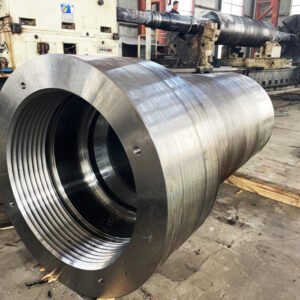
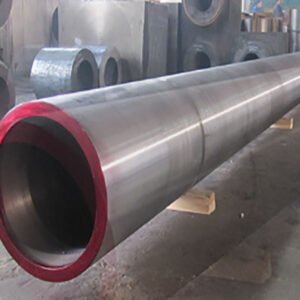
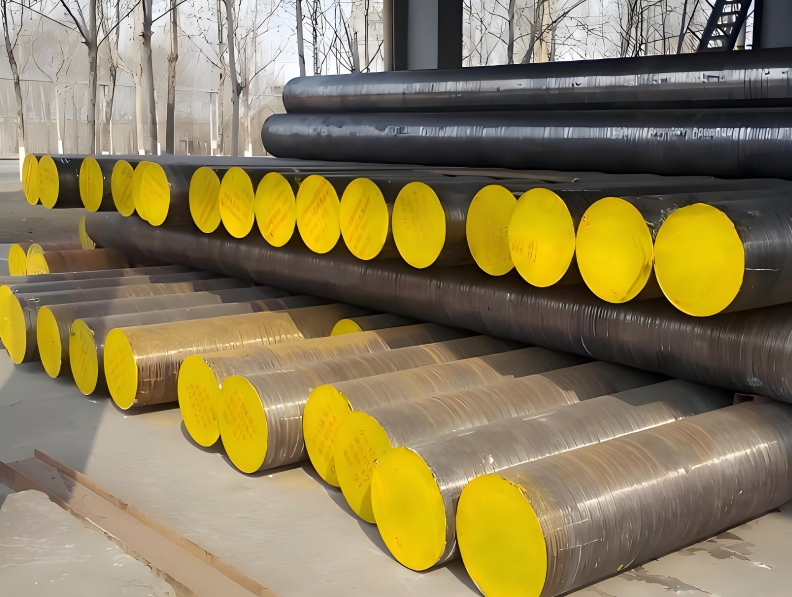
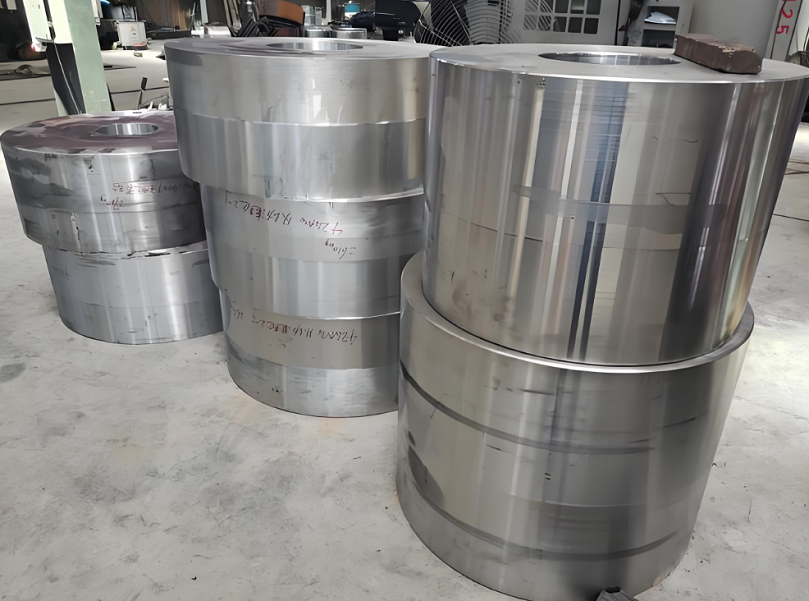
Forged cylinders, forged squares, forged plates, forged rings, forged shafts, forged discs, and modules.
The main heat treatment processes for 4130 forged bars
Quenching
Heat the steel till it surpasses the critical temperature to get a homogeneous austenite structure then cool it swiftly to obtain a martensite structure with a high level of hardness.
Austenitization temperature: It is generally between 840 and 890 ° C. The most usual range is 860 – 880 ° C followed by water quenching. Besides, the water temperature should be kept under 38 °C.
High-temperature tempering
Tempering is a necessary step immediately after quenching, aiming to eliminate the huge internal stress generated during quenching, and adjust the hardness, toughness and plasticity to reach the ideal state.
AISI 4130 Forged Bar Stock’s Main Production Process
Hot processing: Includes hot rolling and hot forging, suitable for manufacturing large-sized and high-thickness products.
Cold processing: Such as cold drawing and cold rolling, the product has high dimensional accuracy and good surface quality, but is usually limited to smaller sizes.
Precision grade: When there are high requirements for dimensional accuracy, cold drawing/cold rolling (such as H11 tolerance) can be selected, or further fine processing (such as grinding, turning, etc.) can be carried out on this basis, to obtain outer diameter tolerance of ±0.02mm and straightness of 0.30/1000mm for high-precision smooth/precision round bar materials.
Delivery status: The products can be delivered in various states, such as black skin, smooth round, grinding, sandblasting, etc. This not only affects the delivery cycle, but also directly relates to whether further processing is needed.
Why choose AISI 4130 forged bar
High strength and high toughness, excellent hardenability, corrosion resistance
AISI 4130 forged bars, as semi-finished products, are mainly applied in:
The petroleum and natural gas industry: valves (body), pump bodies, production trees, pipe joints, flanges, etc.
The automotive industry: safety components, drive shafts, suspension system parts and high-stress bolts
The energy and heavy industry: gearboxes of wind turbines, main shafts, as well as flanges of power stations, etc.
General machinery and molds: spindles, lead screws, high-load gears and other large mechanical parts
What are our production advantages?
- Forging: We have various types of free forging equipment ranging from 5-ton and 8-ton electro-hydraulic presses to 2,000-ton and 2,500-ton rapid forging units.
- Heat treatment: We have 5 sets of heat treatment and quenching units, as well as a complete physical and chemical laboratory, ensuring that every step from heat treatment to quality inspection can be carried out independently and controllably.
- Machining equipment: Large and medium-sized deep hole drilling and boring machines, inner hole hobbing machines, CNC heavy-duty lathes, CNC gantry lathes, machining centers, and external cylindrical grinders can achieve precision processing of long shafts within 12 meters, solving the problem of processing slender shafts.
- Standard delivery cycle: The standard is 30-40 days, which can meet the needs of most routine projects.
- Testing equipment and methods: We are equipped with ultrasonic and magnetic particle non-destructive testing equipment, providing multi-dimensional quality data reports such as chemical composition analysis, mechanical property tests, and metallographic inspection.
- Strict adherence to standards: Products strictly follow international standards such as American Standard (ASTM), Chinese Standard (GB), and European Standard (EN).