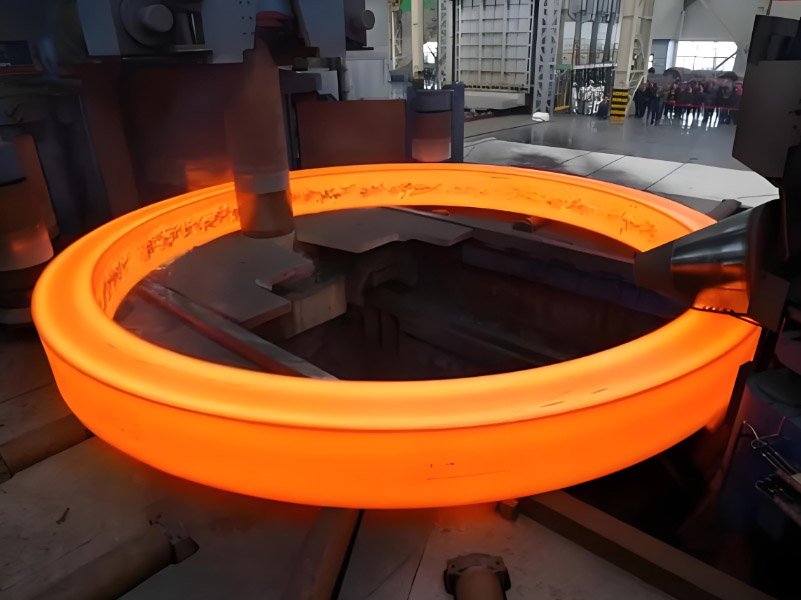
18Mn18CrN Retaining Ring Forging for Thermal Power Generators
18Mn18CrN retaining ring forgings are designed for steam turbine generators, offering high strength, non-magnetic properties, and excellent resistance to stress corrosion. Manufactured through advanced forging and cold expansion processes for reliable performance.
Description
What’s a Retaining Ring in a Steam Turbine Generator?
The retaining ring in a steam turbine generator is essentially a crucial rotor part that keeps the end windings from moving.
Throughout the operation, the rotor spins at an extremely high rate, producing very strong centrifugal forces.
The retaining ring has to be strong enough to handle these forces throughout the operation without changing shape or breaking. A failing retaining ring may cause the entire equipment to be very seriously damaged as well as unexpected downtime. That is why it is viewed as one of the most safety-critical components of the generator system as a whole.
Reasons Why Retaining Ring Forgings Are Very Difficult to Produce
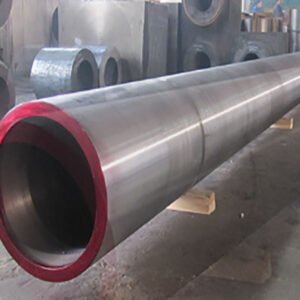
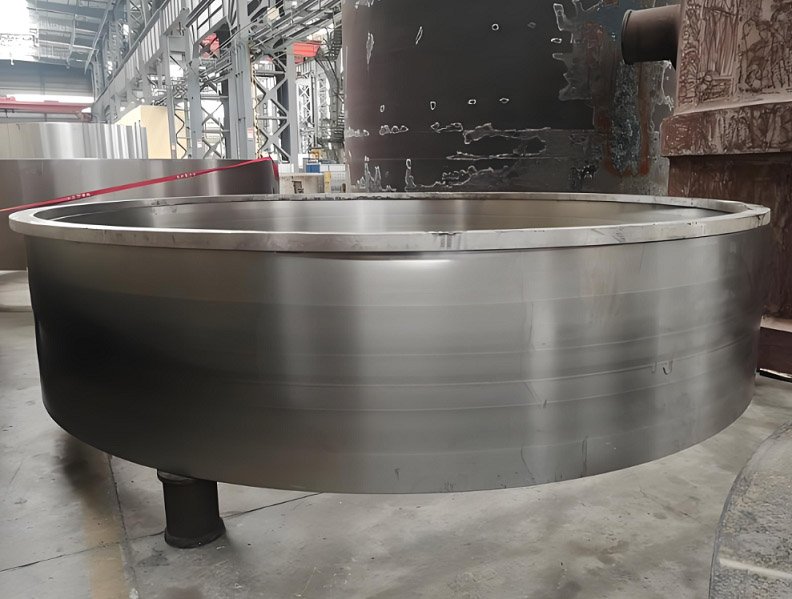
Besides retaining rings being large-sized—usually their diameters are about 1.5 to 2.5 meters—they also have fairly thin walls. Such combination brings great difficulties both in shaping the metal and keeping the strength of the structure.
Meanwhile, they should satisfy several very tough criteria, by way of example:
- Very high strength in both tension and yield
- Good ductility to avoid brittle fracture
- Excellent stress corrosion cracking resistance
- Steady non-magnetic characteristics to not hinder generator performance
The above-mentioned are just some of the properties that have to be combined in one piece, which basically means that selective usage of both raw materials and production technology will be the answer.
Retaining Ring Forgings: Material Consideration for Non-Magnetic Properties
Choosing the right material is key to the retaining ring’s effectiveness.
18Mn18CrN Non-Magnetic Steel
The first thing that comes to mind when considering retaining ring forgings is 18Mn18CrN because it is great at preserving the austenitic phase.
Even though it is non-magnetic, this steel type still boasts an appreciable level of strength and hardness, so this makes it the best candidate for high-speed rotating components.
Other Mn-Cr Series Non-Magnetic Steels
If a project calls for the use of 50Mn18Cr4N or other steel grades from the Mn-Cr series, they can be equally considered since their non-magnetic performance is guaranteed while their mechanical properties still can be adjusted as required.
How Retaining Ring Forgings Are Manufactured
The manufacturing of retaining rings is a multi-stage process where each step directly impacts final performance.
Steelmaking and Ingot Preparation
Production begins with high-purity steel using processes such as:
- VOD (Vacuum Oxygen Decarburization) + LF refining
- Vacuum induction melting combined with ESR
These methods ensure low impurity levels and uniform composition, which are essential for large forgings.
Heavy Forging Process for Ring Formation
Forging is performed on presses exceeding 10,000 tons capacity. The ingot is gradually transformed into a cylindrical ring through:
- Upsetting
- Punching
- Core bar drawing
- Reaming
This stage defines the basic geometry and improves internal structure.
Solid Solution Heat Treatment
The forged ring is heated to the austenitizing temperature and rapidly quenched in water.
Purpose:
- Achieve a uniform austenitic microstructure
- Eliminate carbide precipitation
- Ensure non-magnetic properties
- Improve toughness
Cold Expanding Strengthening (Key Process)
Cold expansion is the most critical step in retaining ring manufacturing.
During this process, the ring undergoes controlled radial expansion on a hydraulic press. This introduces dislocations and deformation twins into the material.
Result:
- Yield strength increases from approximately 300–400 MPa to over 1000 MPa
- Non-magnetic properties are maintained
- Structural stability is significantly improved
Stress Relief Heat Treatment
After cold expansion, stress relief annealing is carried out at around 400°C–450°C.
This step helps:
- Reduce residual stress
- Stabilize dimensions
- Maintain strength without significant loss
Machining and Final Inspection
The retaining ring is then subjected to precision machining and strict inspection procedures.
- Rough and finish turning for dimensional accuracy
- Full dimensional inspection
Non-Destructive Testing (NDT)
To ensure reliability, all retaining rings undergo:
- 100% Ultrasonic Testing (UT)
- Magnetic Particle Testing (MT)
- Dye Penetrant Testing (PT)
What Makes 18Mn18CrN Retaining Ring Forgings Reliable
For power generation equipment, reliability is always the top priority.
18Mn18CrN retaining ring forgings offer:
- Stable non-magnetic performance
- High strength after cold expansion
- Good resistance to stress corrosion cracking
- Long-term operational stability under high-speed conditions
These characteristics make them a proven solution for modern thermal power generators.
Typical Applications
18Mn18CrN retaining ring forgings are widely used in:
- Steam turbine generators in thermal power plants
- Large-scale power generation equipment
- High-speed rotating electrical machinery
Looking for a Reliable Retaining Ring Forging Supplier?
Retaining ring forgings require not only the right material, but also precise control over each manufacturing step—especially cold expansion and heat treatment.
At TIPTOP Forging, we focus on:
- Stable production of Mn-Cr series non-magnetic steels
- Experience with large-diameter ring forgings
- Strict control of key processes such as cold expansion
- Comprehensive inspection to ensure product reliability
If you are sourcing 18Mn18CrN retaining ring forgings or evaluating suppliers for your project, you can share your drawings or technical requirements with us.
We will provide practical solutions based on your application and help ensure long-term performance of your equipment.