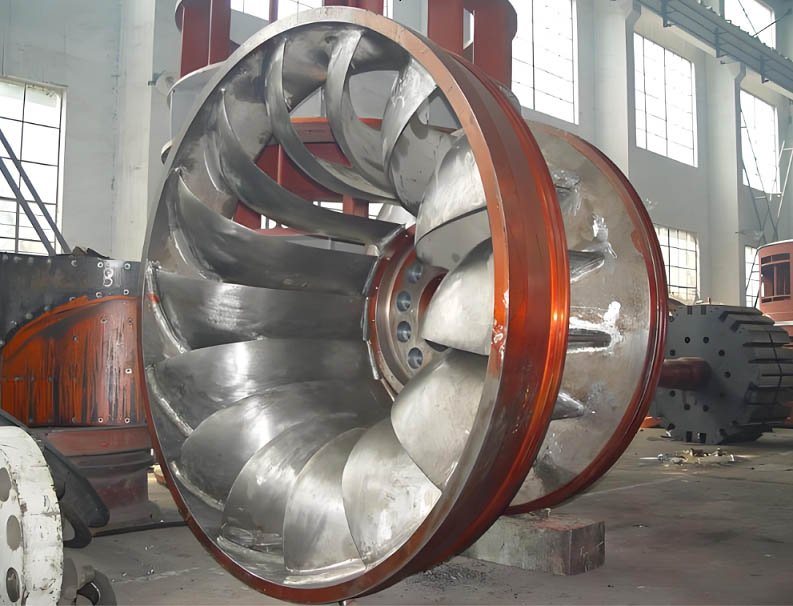
0Cr13Ni4Mo Forged Turbine Runner Hub for Hydropower Turbines
Forged turbine runner hubs are critical core components used in hydroelectric generator units. They are commonly applied in high-head impulse turbines and axial-flow turbines, where they serve as the base structure for installing turbine buckets or blades
Description
Overview of Forged Turbine Runner Hubs
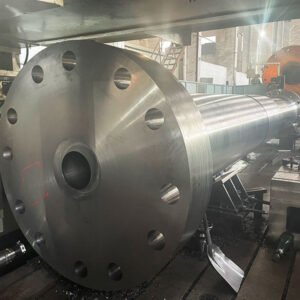
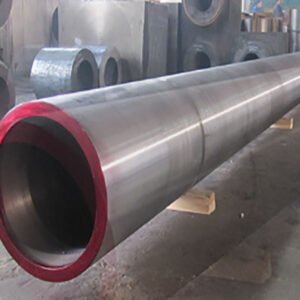
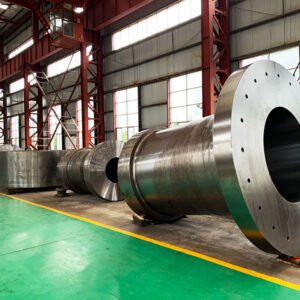
Forged turbine runner hubs are critical core components used in hydroelectric generator units. They are commonly applied in high-head impulse turbines and axial-flow turbines, where they serve as the base structure for installing turbine buckets or blades.
As one of the main load-bearing parts of the turbine runner, the hub performs several key functions, including torque transmission, structural support, and resistance to complex alternating loads during turbine operation.
With the development of hydropower equipment toward larger capacities and higher water heads, forged turbine runner hubs have gradually become the preferred solution in the industry. Compared with cast components, the forging process effectively eliminates casting defects, improves metal flow distribution, and significantly enhances the density, uniformity, and overall mechanical performance of the material.
Product Definition and Structural Characteristics
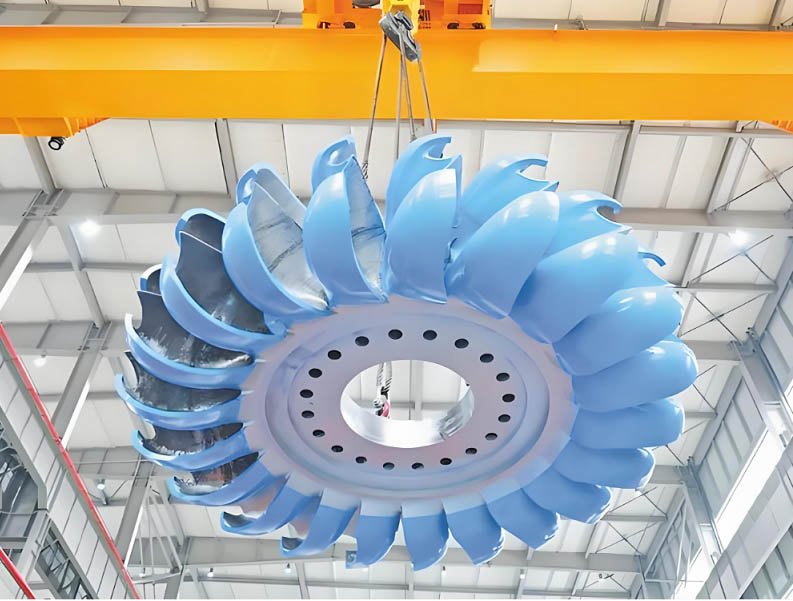
Forged turbine runner hubs are one of the main structural components that form the turbine runner. They are typically assembled with multiple buckets (for impulse turbines) or blades (for axial-flow turbines) through welding or mechanical connections to form a complete runner assembly.
In forged-welded runner structures, the hub forging acts as the central structural base, connecting the turbine shaft, fixing the buckets or blades, and transmitting mechanical power during operation.
Typical large impulse turbine hub forgings have the following structural characteristics:
- Extra-large dimensions– Outer diameter can reach 7–5 meters, with a maximum thickness of approximately 1.2 meters
- Ultra-heavy weight– Finished hub weight can reach 105–107 tons, while the forged blank may exceed 150 tons
- Complex structural design– Precision welding interfaces must be reserved to ensure accurate assembly and high welding quality
Material Selection for Turbine Runner Hub Forgings
Turbine runner hub forgings are typically manufactured using high-strength martensitic stainless steel to meet the demanding requirements of high-head hydropower turbines, including resistance to impact loads and cavitation.
Typical Material Grades
Common materials include:
- 0Cr13Ni4Mo
- 0Cr13Ni5Mo
- 0Cr16Ni5Mo
These materials correspond to the internationally recognized F6NM martensitic stainless steel series, which are widely used in hydropower turbine components.
Steelmaking Requirements
To ensure high material purity and performance, the steel is produced using 300-ton class martensitic stainless steel ingots, refined through processes such as:
- VOD (Vacuum Oxygen Decarburization / Vacuum Degassing)
- Electroslag Remelting (ESR)
Material Performance Characteristics
The selected materials provide a combination of:
- High strength
- High toughness
- Excellent fatigue resistance
Under extreme operating conditions, such as 700-meter water head, the instantaneous impact force acting on turbine buckets can be equivalent to the weight of two heavy-duty trucks, requiring exceptional material reliability.
Manufacturing Process of Forged Turbine Runner Hubs
Smelting and Ingot Casting
The manufacturing process begins with electric arc furnace (EAF) smelting, followed by ladle refining (LF/VD/VOD) and vacuum degassing to ensure material purity.
Ultra-large hub forgings require 300-ton martensitic stainless steel ingots, and the forging blank may exceed 160 tons.
These components represent some of the largest martensitic stainless steel forgings used in hydropower projects worldwide.
Advanced Forging Process
To manufacture ultra-large martensitic stainless steel forgings, a three-stage temperature-controlled forging process is adopted.
Key techniques include:
Multi-directional upsetting and drawing
Repeated upsetting and drawing operations help eliminate internal defects such as porosity and gas cavities within the steel ingot.
Precise temperature control
Strict control of the forging temperature during each stage prevents grain coarsening and ensures uniform microstructure.
Stress distribution control
Proper forging deformation ensures balanced internal stress distribution throughout the hub forging.
Heat Treatment Process
An integrated metallurgy–forging–heat treatment manufacturing system is applied to achieve optimal mechanical properties.
Key heat treatment steps include:
- Post-forging heat treatmentto remove forging stress and refine grain structure
- Quenching and tempering treatment(quenching + high-temperature tempering) to obtain a stable tempered sorbite microstructure
- Shot peening strengthening, which introduces surface compressive stress and improves fatigue resistance
Inspection and Quality Control
Strict inspection procedures are carried out in accordance with JB/T 15244-2025 – Technical Specification for Stainless Steel Forgings of Impact Turbine Runners.
Quality inspection includes:
- 100% Ultrasonic Testing (UT)to detect internal defects
- Magnetic Particle Testing (MT)for surface crack detection
- Mechanical property testingto verify strength and toughness performance
These procedures ensure the reliability and safety of the turbine runner hub during long-term hydropower operation.
Typical Application Case – Large Hydropower Projects
Forged turbine runner hubs are widely used in large-scale hydropower generation projects, particularly those involving high-head impulse turbines.
Example project application:
Zara Hydropower Project
Unit capacity: 500 MW per unit
Runner outer diameter after machining: 6.23 meters
Runner maximum width: 1.34 meters
Hub forging diameter: 4.72 meters
Hub forging height: 1 meter
Finished hub weight: approximately 107 tons
This project demonstrates the successful manufacturing of ultra-large martensitic stainless steel turbine runner hub forgings, representing a major technological breakthrough in large hydropower equipment manufacturing.
Technical Advantages of Forged Turbine Runner Hubs
High Structural Density
The forging process eliminates casting defects and produces a material density close to 100%, significantly improving structural reliability.
Uniform Mechanical Properties
Multi-directional forging creates optimized metal flow lines, resulting in balanced mechanical performance in all directions.
High Operational Reliability
Excellent fatigue resistance and crack propagation resistance allow the component to withstand high-frequency dynamic loads under extreme hydropower conditions.
Stable Manufacturing Capability
The production process has reached a mature stage, enabling stable large-scale manufacturing of ultra-large hydropower turbine hub forgings.