
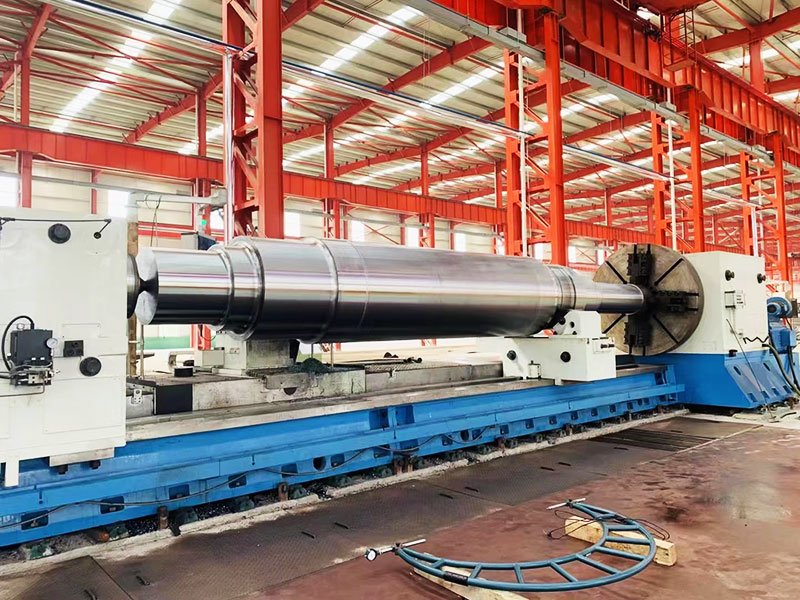
Plate Rolling Mill Roller for Heavy-Duty Metal Forming
A Plate Rolling Mill Roller—often known as a support roller, back-up roller, or plate mill roll—is a critical component used in heavy plate rolling mills. These rollers carry extremely high loads and ensure stable, accurate plate forming. For large plate mills and heavy rolling lines, the roller must maintain high dimensional accuracy, excellent hardness uniformity, and reliable internal quality.
Structure and Technical Requirements of Plate Rolling Mill Roller
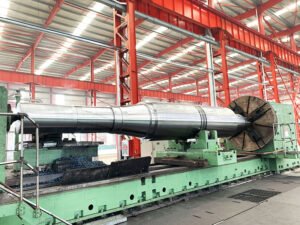
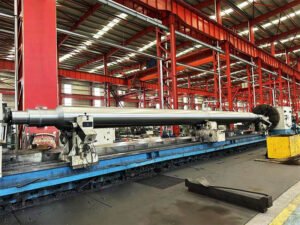
Large plate rolling mill rollers are generally produced from high-chromium alloy forged steel, providing the strength and wear resistance required in demanding rolling conditions. For heavy-duty plate rollers, both geometry and hardening quality directly influence the mill’s accuracy and output.
1. Geometric Precision
To stabilize rolling forces and minimize vibration, several accuracy requirements must be met:
Cylindricity of D₁: ≤ 0.02 mm/1000 mm
Runout to datum A/B: ≤ 0.02 mm
Neck diameter (D₅) cylindricity & coaxiality: ≤ 0.03 mm
Taper surfaces (1:5.647058): parallelism and runout ≤ 0.03 mm
20° chamfers & sealing R-surfaces: runout ≤ 0.03 mm
These tolerances match the precision required in plate mills, hot rolling lines, and wide-heavy-plate production.
2. Heat Treatment & Hardness
Roll body hardness: HS50–HS60
Hardness difference within the body: ≤ 5HS
Overall hardness after final heat treatment: HB269–HB325
Uniform hardness is essential to prevent strip thickness variation.
3. Non-Destructive Testing
Ultrasonic testing (UT) after rough machining
Magnetic particle inspection (MT) after finish machining
This ensures the roller core is completely free of internal cracks and material segregation.
Manufacturing Process and Technical Challenges
1. Manufacturing Routes Based on Weight
Large Plate Rolling Mill Rollers can range from 30 tons to over 220 tons, requiring different process routes:
Rollers >70 Tons
Due to furnace size limits or temperature uniformity issues:
Quenching, tempering, and surface hardening must often be completed in a single setup inside the hydraulic press facility.
This requires precise coordination between forging, heat treatment, and machining teams.
Rollers <70 Tons
Follow the conventional process:
Forging → Rough machining → Heat treatment → Finish machining → NDT
2. Key Manufacturing Challenges
(1) Weight & Handling
Ultra-large rollers (e.g., 220+ ton support rollers) exceed typical crane and machining capacity, making:
transport
lifting
clamping
machining stability
major engineering challenges.
(2) Precision Requirements
Modern plate mills require:
roll body surface roughness Ra ≤ 0.8 µm
high accuracy on neck, taper and groove areas
minimized runout to maintain rolling thickness control
(3) Process Complexity
First-time production of rollers above 200 tons requires:
new tooling
special heat treatment procedures
custom turning and grinding setups
This is often the “make-or-break” point for mill roller manufacturers.
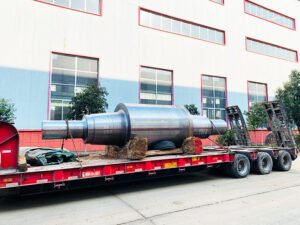
Applications and Functions of Plate Rolling Mill Rollers
1. Core Functions
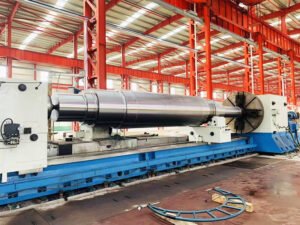
A Plate Rolling Mill Roller is designed to:
Support the rolling force during thick plate reduction
Maintain equipment stability and strip flatness
Ensure uniform pressure distribution across the plate width
Improve rolling accuracy, efficiency, and rolling capacity
2. Application Fields
Used across:
Hot plate rolling mills
Cold plate rolling mills
Wide-thick plate production
Heavy section steel rolling lines
Metallurgical and steelmaking plants
Material Selection and Processing Logic
1. Material
Most Plate Rolling Mill Rollers use:
High-chromium alloy forged steel
Cr-Mo alloy steel
NiCrMo hardened rolls
High-strength forged backing rolls
These materials provide:
high load-bearing capability
resistance to thermal fatigue
stable hardness through thick sections
2. Processing Flow
Each stage must be strictly controlled:
Forging
Ensures dense microstructure, eliminating shrinkage cavities and segregation.
Heat Treatment
Quenching + tempering + surface hardening for balanced hardness and toughness.
Precision Machining
Includes turning, deep-hole boring, taper machining, grinding, and polishing.
Quality Control & NDT
UT, MT, hardness test, chemical analysis, surface inspection.
For oversized rollers, additional challenges include:
thermal uniformity during heat treatment
deformation control during cooling
precise grinding of large tapers and neck diameters
Conclusion
A Plate Rolling Mill Roller is an irreplaceable component in plate rolling systems.
Its performance depends on the combination of:
correct material selection
stable forging quality
precise heat treatment
strict machining accuracy
reliable non-destructive testing
For large or ultra-heavy rollers, manufacturing complexity increases significantly, requiring advanced equipment and extensive experience to ensure high stability and long service life in demanding metallurgical environments.