
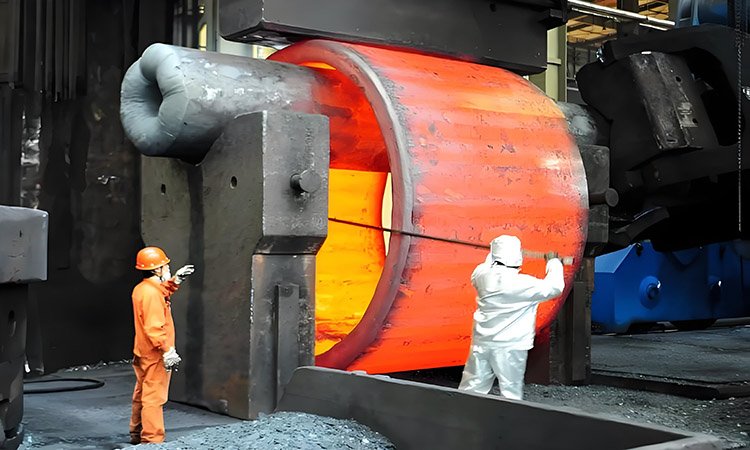
Advanced Heat Treatment Capabilities at Tiptop Forging
At Tiptop Forging, we provide advanced heat treatment services to ensure our forgings achieve the desired mechanical properties and performance.
Our workshop is equipped with computer-controlled heat treatment furnaces, offering precise temperature uniformity and stable quality for large and heavy steel forgings.
State-of-the-Art Heat Treatment Equipment
We operate a range of regenerative natural gas heating furnaces, all managed through a central computer control system for accuracy and consistency.
Our major equipment includes:
8 regenerative, computer-controlled large trolley-type gas heating furnaces
8 regenerative post-forging heat treatment furnaces
3 box-type quenching and tempering furnaces
1 well-type furnace (Φ3×12m) for deep heat treatment of long components
All furnaces maintain uniform temperature distribution and precise control, ensuring reliable performance during every heat treatment cycle.
We also use imported quenching media, which significantly enhance product quality, mechanical stability, and surface finish.
Comprehensive Heat Treatment Processes
Our facility can perform a full range of heat treatment processes to meet various material and performance requirements:
Annealing
The annealing manner entails heating the metal to a crucial temperature accompanied by way of gradual cooling.
This reduces hardness, improves plasticity, and enhances machinability — perfect for making ready forgings for subsequent machining or forming operations.
Normalizing
In normalizing, the workpiece is heated above the imperative temperature (Ac₃ or Accm +30–50°C) and air-cooled.
This procedure refines grain structure, improves strength, and produces reasonable hardness — making it appropriate for medium-strength applications.
Quenching
Quenching entails heating the metal to the necessary temperature and unexpectedly cooling it, generally in oil or water.
It dramatically will increase hardness and power whilst lowering plasticity, forming the basis for high-strength forgings.
Tempering
After quenching, tempering reheats the metal to under the Ac₁ temperature (727°C) accompanied via air or oil cooling.
This reduces brittleness, relieves interior stresses, and improves sturdiness and ductility.
Quenching and Tempering (Q&T)
Quenching accompanied with the aid of high-temperature tempering varieties tempered sorbite — a microstructure that combines excessive power with magnificent toughness, appropriate for heavy-duty industrial functions such as strain vessels, shafts, and turbine components.
Quality, Precision, and Reliability
Through strict temperature control, superior furnace technology, and optimized method parameters, Tiptop Forging ensures every forging undergoes uniform, controlled, and repeatable warmth treatment.
Our dedication to precision warmth cure ensures steady mechanical homes and lengthy provider lifestyles for each aspect we produce.