Large Gear Ring Forgings for Mining Equipment | Ball Mill & SAG Mill Gear Ring Manufacturer
Description
1.Introduction to Large Gear Ring Forgings for Mining Equipment
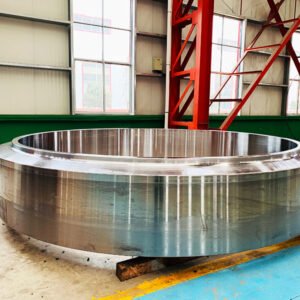
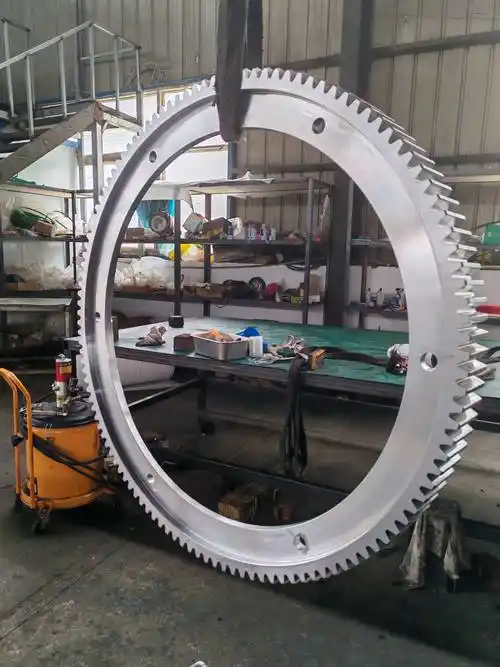
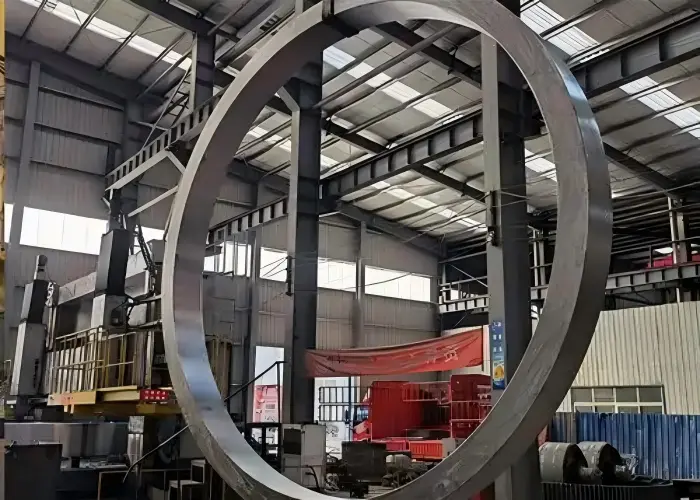
Large gear ring (gear rim) forgings are heavy ring-shaped forgings and serve as core transmission components for mining mills, rotary kilns, crushers, hoists, and other equipment. They are formed by integral forging, which distinguishes them from cast gear rings. They withstand heavy loads, impact, and alternating torque under mining conditions, and play the role of power transmission and speed reduction.
Mining sites have harsh working conditions — heavy dust, frequent impact loads, and large temperature differences between day and night. Once a gear ring fails, the entire production line stops. Therefore, gear ring forgings have extremely high requirements for internal density, strength, toughness, hardness uniformity, and non-destructive testing levels. They are widely used in ball mills, SAG mills, rotary kilns, mining hoists, and other large mining equipment.
2.What Forging Materials Are Commonly Used for Large Gear Ring Forgings for Mining Equipment?
The commonly used grades are as follows, depending on load, impact conditions, and whether quenching and tempering plus surface hardening are required:
- 42CrMo: The most common general-purpose material. Quenched and tempered, it offers high strength and good toughness. Suitable for medium-to-large mill gear rings. It has good fatigue resistance and wear resistance, and is the first choice for most mining main gear rings.
- 40CrNiMoA: For heavy-load, high-impact conditions. With higher alloy content and excellent hardenability, it maintains stable core properties in large cross-section forgings. Used for large SAG mills and super-heavy mining machine gear rings.
- 34CrNiMo6: A high-end material benchmarked against imported grades. For large cross-section, thick-walled ring parts. It has excellent hardenability and impact fatigue resistance, and is mostly used for exported large mining equipment.
- 45# steel: For light-load, low-impact, small mining equipment gear rings. Low cost, generally only normalized, and not suitable for heavy-load impact conditions.
- 4130: A commonly used American standard material for export. It corresponds to Chinese standard 30CrMo. Suitable for medium-load ring forgings, often used in overseas mining projects.
3.What Is the Forging Process for Large Gear Ring Forgings for Mining Equipment?
Complete process: raw material inspection → cutting → ingot/billet heating → open die pre-forging (upsetting + punching) → ring rolling and expanding (ring rolling forming) → post-forging heat treatment (normalizing/annealing) → rough NDT → rough machining → quenching and tempering → finish machining with allowance reserved → final NDT → dimension inspection → finished product warehousing.
4.Product Features of Large Gear Ring Forgings for Mining Equipment
4.1 Continuous and complete metal flow lines: Ring rolling ensures metal fibers are distributed along the circumferential direction of the ring. Compared with cast gear rings, this significantly improves bending fatigue resistance and impact resistance, making tooth breakage less likely.
4.2 Dense structure with few defects: Forging compacts internal porosity and blowholes. There are no casting shrinkage cavities or sand holes inside, making it suitable for long-term alternating heavy-load conditions.
4.3 Stable mechanical properties: Quenching and tempering can achieve a good match between high tensile strength and impact toughness. The tooth surface can be induction-hardened, giving the tooth surface wear resistance while the base body resists impact.
4.4 Strong dimensional adaptability: We can produce large-diameter heavy ring forgings with diameters up to several meters, meeting the matching needs of large ball mills and SAG mills.
4.5 Longer service life: Under mining impact, dust, and heavy-load conditions, forged gear rings generally last 2–3 times longer than cast gear rings, reducing downtime and repair frequency.
4.6 NDT and traceability: UT/MT can be performed. Each batch is provided with a material report, heat treatment curve, and NDT report for full quality traceability.
5.Our Advantages in Producing Large Gear Ring Forgings for Mining Equipment
5.1 Delivery assurance: Integrated production from forging, heat treatment, NDT to rough machining. Fewer outsourced processes, controllable delivery time. Support for small-batch or large-batch production according to orders.
5.2 Flexible material selection and customization support: We can produce 42CrMo, 40CrNiMoA, 34CrNiMo6, 4130, and other Chinese/American/German standard alloy forgings. We can recommend material solutions based on customer drawings and actual working conditions, and can handle export orders.
5.3 Full-process heat treatment capability: We have our own large car-bottom heat treatment furnaces. Quenching and tempering and normalizing processes are stable. Grain structure and hardness gradient are strictly controlled, and the core properties of large cross-section forgings can also meet standards.
5.4 Strict NDT control: UT ultrasonic testing and MT magnetic particle testing are performed. We can meet the NDT standards of domestic mining and overseas projects. Each forging is accompanied by complete quality assurance documents (material certificate, heat treatment records, NDT report).
5.5 Precise control of dimensions and allowances: Forging blank allowances are controllable, helping customers reduce subsequent machining costs. Rough machining delivery is supported, reducing customer processing pressure.
5.6 Rich mining supporting experience: Long-term supporting experience with gear ring forgings for ball mills, SAG mills, and mining hoist gear rings. We are familiar with heavy-load impact conditions in mining and can proactively avoid common failure risks such as forging cracking and coarse grains.
5.7 Guaranteed delivery: Integrated production from forging, heat treatment, NDT to rough machining. Fewer outsourced processes, controllable delivery time. Support for small-batch or large-batch production according to orders.