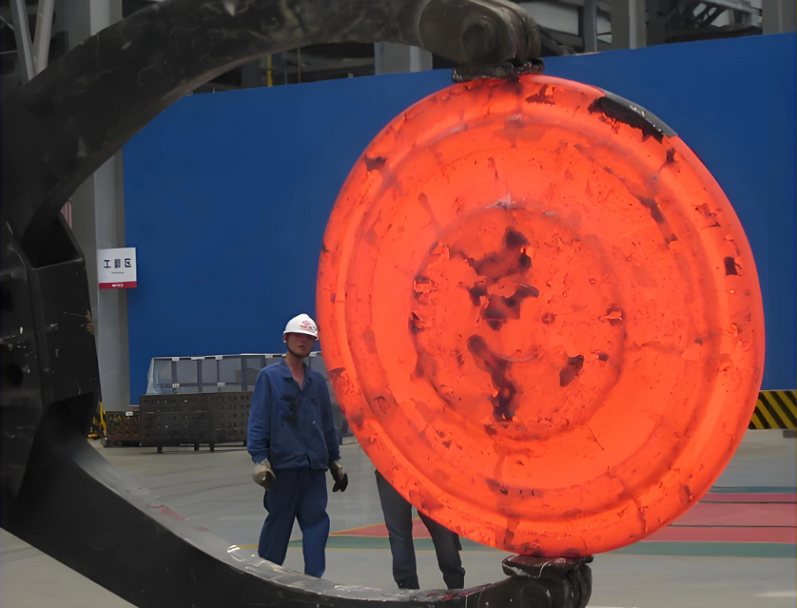
GH4169/Inconel 718 Turbine Disk Forgings for Aerospace Applications
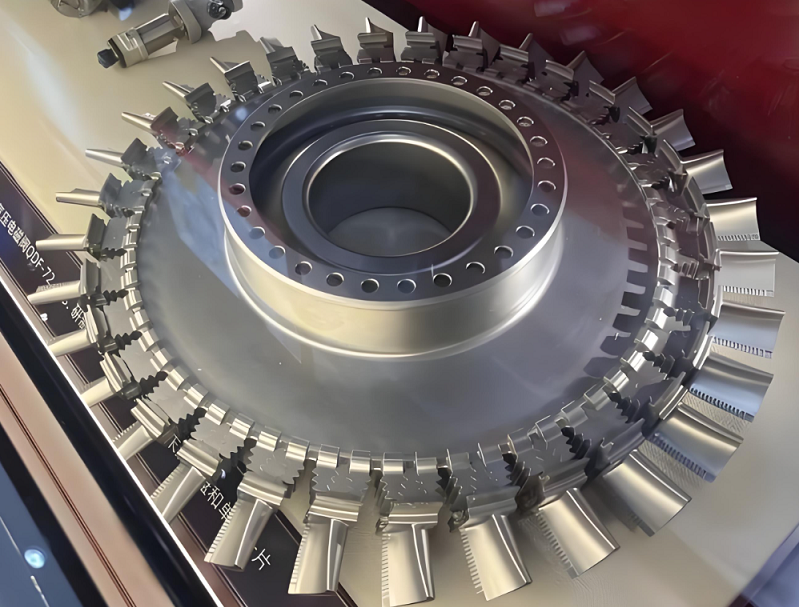
The turbine disk is a classic nickel-based high-temperature alloy disk component used in China’s aircraft engines. It is widely employed in rotating parts at the hot end that operate below 750℃. Commonly used material: GH4169.
Description
Product Introduction
The turbine disk is a classic nickel-based high-temperature alloy disk component used in China’s aircraft engines. It is widely employed in rotating parts at the hot end that operate below 750℃. Commonly used material: GH4169
Material Fundamentals and Composition for GH4169/Inconel 718 Turbine Disk Forgings
GH4169 (also known as Inconel 718) is a nickel-chromium iron alloy that has been strengthened in hardness through special heat treatment. Its biggest advantage is that it maintains high performance even in extremely cold conditions of -253℃ or at high temperatures of 650℃. Especially, below 650℃, its yield strength (which can be understood as “the ability to resist permanent deformation when being pressed or pulled”) can reach 1030 megapascals. Among similar deformation high-temperature alloys, this strength ranks first.
Typical Chemical Composition (wt.%):
| Element | Typical Content Range (wt.%) |
| (Ni) | 50 – 55 |
| Cr | 17 – 21 |
| Fe | Balance |
| Nb | 4.75 – 5.50 |
| Mo | 2.80 – 3.30 |
| Ti | 0.65 – 1.15 |
| Al | 0.20 – 0.80 |
| C | ≤ 0.08 |
Forging Capability
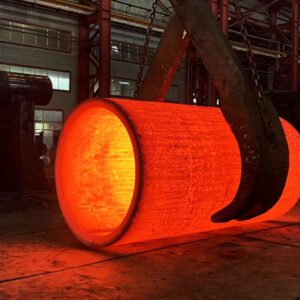
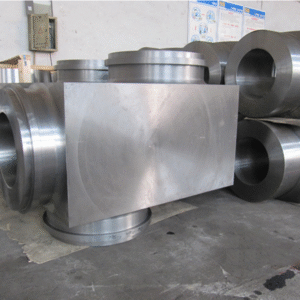
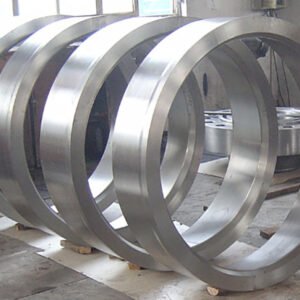
TIPTOP Heavy Forging specializes in producing large and medium-sized open-die forgings with advanced forging equipment and comprehensive supporting facilities. Our company is equipped with one 12,000T free forging hydraulic press and one 130T fully hydraulic forging manipulator, as well as one 4,000T free forging hydraulic press paired with a 35T hydraulic forging manipulator.
Forging Process for GH4169/Inconel 718 Turbine Disk Forgings
1. Master Alloy Melting and Ingot Preparation in the Forging Process
The double-stage smelting process of vacuum induction melting (VIM) and vacuum arc remelting (VAR) is adopted to ensure purity and reduce segregation.
2. Ingot blanking
Large-scale isothermal / hot die forging is carried out to control the forging ratio and deformation temperature, refine the grain structure and obtain the required fiber flow lines for the disk.
3. Hot die forging and isothermal forging
4. Machining
5. Heat treatment
6. Strict non-destructive testing (ultrasonic, penetrant, X-ray) to detect internal inclusions and cracks.
Advantages of Forging for GH4169/Inconel 718 Turbine Disk Forgings Compared to Casting
Compared with casting turbine discs, forged turbine discs have significant advantages in mechanical properties, microstructure uniformity, and reliability. They are particularly suitable for applications in aerospace engines and gas turbines where safety requirements are extremely high.
- Higher strength and fatigue life
- Elimination of internal defects
- Better resistance to creep and thermal mechanical fatigue
Other Frequently Asked Questions:
What is the size range we can produce?
From 200 mm to 1,360 mm.
How is inspection performed?
Non-destructive testing (NDT), mechanical testing and metallographic analysis, dimensional and geometric tolerance: Mainly using a three-coordinate measuring machine.