

In heavy industrial fields, the forging manufacturing process is not chosen for convenience. It is selected because the component must survive real working conditions—continuous load, repeated stress, and long service cycles. Whether the part is used in oil and gas equipment, mining machinery, or power transmission systems, forging remains one of the most reliable manufacturing routes.
Unlike processes that focus mainly on shape, forging manufacturing process emphasizes how metal behaves internally during deformation. This internal behavior is what ultimately determines whether a component performs consistently in service.
Understanding What the Forging Manufacturing Process Really Does to Metal
At its core, the forging manufacturing process changes the way metal is structured rather than simply reshaping it. When steel is heated and compressed under controlled force, its internal grains elongate and align along the direction of stress. This flow of material creates a denser, more continuous structure.
Because of this grain alignment, forged components usually show better fatigue resistance and impact strength than parts made by casting or machining from solid bar. In practical terms, this means forged parts are less likely to fail unexpectedly when exposed to cyclic loading or shock.
This structural advantage explains why forging process in manufacturing is still widely specified for critical mechanical components.
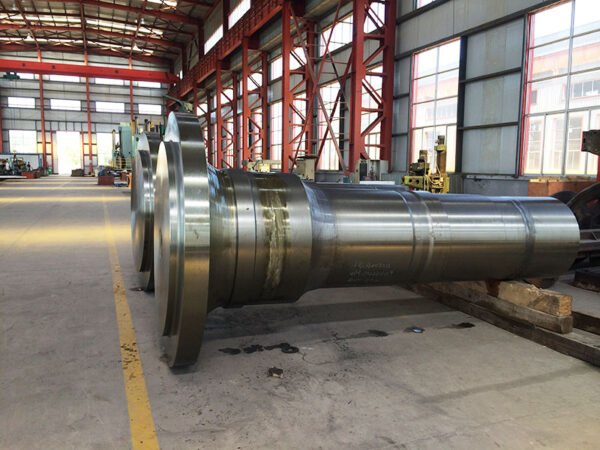
3.6MW Wind Turbine Main Shaft for Power Generation
The 3.6MW wind turbine shaft is a critical transmission component in large-scale wind power systems, responsible for transferring torque from the rotor hub to the gearbox or generator. Forged from…
How the Forging Manufacturing Process Is Carried Out in Practice
In real production environments, the forging manufacturing process follows a logical progression rather than a rigid formula. Steel billets are first prepared and heated according to the material grade. Temperature control at this stage directly affects how the metal flows during deformation.
Once heated, the material is shaped using open-die forging, closed-die forging, or ring rolling, depending on the geometry and service requirements of the component. During deformation, pressure is applied gradually to ensure the material flows into the required form without introducing internal stress or defects.
After forging, heat treatment becomes a key step. It stabilizes the microstructure and brings the material to the required mechanical properties. Final machining and inspection ensure that the forged component meets dimensional and performance expectations before delivery.
Matching the Forging Manufacturing Process to Real Industrial Components
Different products demand different forging strategies. For large shafts and heavy sections, open-die forging allows deep material deformation and flexible sizing. This approach is commonly used where strength and reliability matter more than tight shape complexity.
For parts such as connecting rods or precision mechanical components, closed-die forging provides better shape consistency while maintaining internal strength. In applications like flanges, bearing rings, and pressure-retaining parts, ring rolling offers an efficient way to achieve balanced strength and material utilization.
In each case, the forged manufacturing process is selected based on how the part will function in service, not just how it appears on a drawing.

ASTM A182 F55 Duplex Stainless Steel Flange
The ASTM A182 F55 duplex stainless steel flange is best described as a pipeline connection component made by a…
Why Forging Manufacturing Process Remains the Preferred Choice for Critical Parts
The advantages of the forging manufacturing process become most apparent over time. Forged components tend to maintain their mechanical performance under long-term loading, vibration, and temperature variation. Reduced internal defects and refined grain structure translate into predictable service behavior.
For industries where downtime is costly and safety margins are tight, forging offers a level of confidence that alternative manufacturing methods often struggle to provide. This is why forged crankshafts, valves, fittings, and structural parts remain standard in many heavy-duty systems.
TIP TOP Forging Experience in Forging Manufacturing Process Control
At TIP TOP Forging, the forging manufacturing process is treated as a controlled engineering system rather than a simple forming step. Each project begins with an evaluation of material grade, component geometry, and working conditions.
We manufacture large open-die forge pieces, closed-die forge pieces, and rolled rings with supporting department of heat treatment and machining. We assure stable quality and performance repeatability for our industrial customers worldwide by controlling every step of the forging manufacturing process.

SA182 F316L Forged Ring – A Corrosion-Resistant Austenitic Stainless Steel Forgings
SA182 F316L forged ring is the one of the series austenitic stainless steel forging with low-carbon…
Forging Manufacturing Process as a Long-Term Engineering Solution
The main reason why the forging manufacturing process is selected is that it can consistently produce desired results rather than it being a traditional method. Forging is the best way to assure the structural soundness of the components of the pressure, fatigue, and harsh operating environment type which is tested and proven.
Forged parts are still a reliable basis for the mechanical systems that are safe, long-lasting, and efficient as the equipment for industries keep developing.
Work with a Forging Manufacturing Process Partner You Can Rely On
Choosing the correct forging manufacturing process is a major factor, but besides that, an agreement with the partner who knows how forged parts behave in actual operation is just as crucial.
TIP TOP Forging assists its customers from the initial design stage to final delivery, helping them choose materials, forging methods, and cost-efficient manufacturing solutions. No matter whether your work involves forged crankshafts, flanges, shafts, or custom industrial components, our engineering team is available to look over the drawings, specifications, and application requirements.
Should you be initiating a new project or planning to enhance an existing forging manufacturing process, do not hesitate to get in touch with TIP TOP Forging for technical advice or quotation support. Proper specifications will result in higher-quality products—and we have the expertise to help you proceed without any doubts.